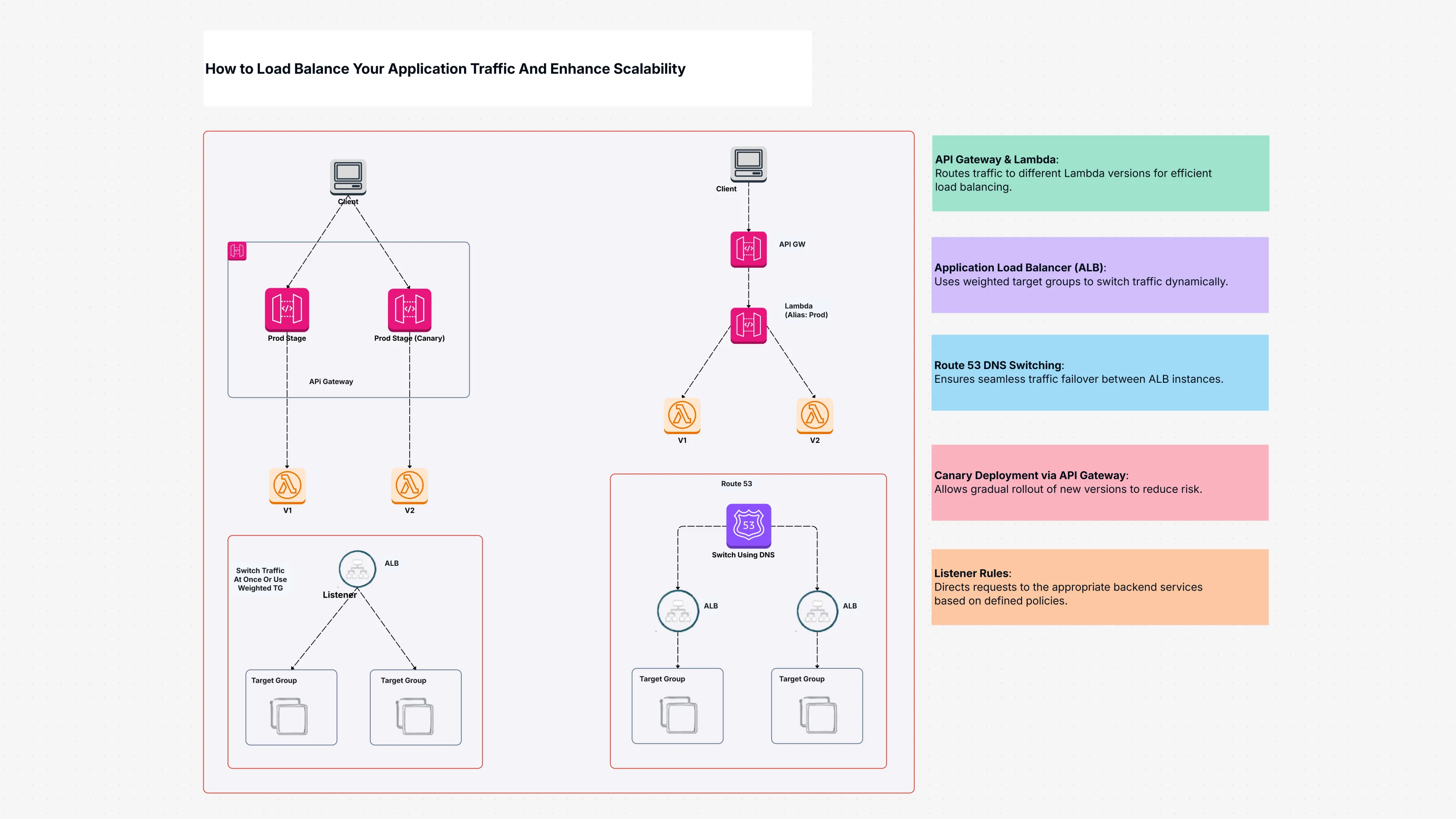
What Is Load Balance Your Application Traffic Template?
This Load Balance Your Application Traffic template helps you understand and design how to manage increasing traffic loads for your applications.
It explains how different Load Balancing for Applications methods work, including:
- Weighted target groups: A smart way to send more or less traffic to specific groups of servers, useful for testing new versions.
- ALB listener configurations: How your Application Load Balancer (ALB) hears for requests and directs them to the right place.
- DNS-based routing through Route 53: Using your domain name system to send users to different renditions or locations of your application.
By using these strategies, organizations can distribute traffic competently, prevent downtime, and optimize how their backend resources are used. It's all about assuring smooth Traffic distribution and dispatching Load balancer configuration.
Why Is Load Balance Your Application Traffic Template Helpful?
Using this Load Balancing for Applications template with Cloudairy brings many benefits:
- Handle More Visitors: Helps you design systems that can manage accelerating traffic without slowing down.
- Prevent Downtime: Shows you how to set up your apps so they wait online even if one server has a problem.
- Smooth Updates: Learn how to slowly switch traffic to new versions of your app without disruption.
- Use Resources Wisely: Optimize how your servers and other resources are used, except money and improving performance.
- Clear Traffic Map: Cloudairy's visuals help you map out your Cloud traffic management strategy, making complex routing easy to understand.
Who Needs Load Balance Your Application Traffic Template, and When?
This Load Balance Your Application Traffic template is perfect for anyone responsible for keeping applications fast, reliable, and available, especially as they grow.
It's super useful for:
- Cloud Architects & Engineers: To design and implement robust Load balancer configuration and Traffic distribution strategies.
- DevOps Teams: To ensure smooth deployments and high Application scalability.
- Developers: To understand how their applications will handle traffic and scale.
- IT Managers: To ensure continuous application performance and availability.
Load Balance Your Application Traffic Template is useful when you are:
- Expecting a lot more users for your application.
- Establishing new features or versions of your app and want a controlled rollout.
- Oppressive to prevent downtime and ensure your app is always available.
- Improving costs by making sure your resources are used efficiently.
- Preparing for high availability and disaster recovery for your applications.
The Main Components Inside Load Balance Your Application Traffic Template
Here are the main parts you'll find in this template for cunning your Load Balancing for Applications strategy:
- Client Requests: Represents the incoming traffic from users oppressive to access your application.
- API Gateway: Manages how requests for your APIs are routed competently.
- ALB Listener: This is the part of your Application Load Balancer that listens for appearance traffic and directs it.
- Target Groups: Groups of waiters or other resources that receive traffic from the load balancer.
- Lambda Functions: Small pieces of code that can run recklessly to handle backend logic, often triggered by API Gateway or ALB.
- Weighted Target Group: A singular type of target group that lets you send a specific percentage of traffic to different versions of your application (e.g., 90% to old, 10% to new).
- Route 53: AWS's DNS service that can direct traffic grounded on different rules, like sending users to the closest server or to a specific version.
- DNS Resolution: The method where a domain name (like https://www.google.com/search?q=yourwebsite.com) is translated into an IP address, ensuring traffic goes to the correct place.
- V1 and V2 Versions: Represents different releases of your application, having for controlled rollouts.
- Traffic Switching: The process of easily moving user traffic from one version of your application to another.
- Production Stages: Defines different phases of your live application deployment, like "live" (main version) and "canary" (small test group for new version).
- Failover Configuration: How you set up your system to impulsively switch to a backup if the main one fails, ensuring reliability.
- Scalability Mechanisms: The tools and strategies used to allow your application to grow and handle more users (like auto-scaling).
How to Open Load Balance Your Application Traffic Template in Cloudairy ?
Ready to design your smart Load Balancing for Applications strategy? Here’s how to open this template in Cloudairy:
- Log In: Log in to your Cloudairy account.
- Find Templates: Go to the "Templates" section from your dashboard.
- Search: Look for “Load Balance Your Application Traffic.”
- Select & Open: pick the template from the options and click “Open Template” to load it into your workspace.
- Customize: Adjust it to fit your specific application and traffic necessarily.
How to Use Cloudairy for Load Balance Your Application Traffic Template?
Cloudairy makes it easy to design and visualize your Traffic distribution and Load balancer configuration:
- Select the Template: Open the "Load Balance Your Application Traffic" template from Cloudairy’s library.
- Add/Modify Components: Drag and drop or adjust parts like ALB, API Gateway, and Route 53 to match your setup.
- Collaborate: Work with your team directly in Cloudairy to refine your traffic distribution strategies.
- Visualize Flows: See how traffic routes and how different components depend on each other.
- Export Your Plan: Export the final diagram for easy implementation and documentation.
Summary of Load Balance Your Application Traffic Template
This Load Balance Your Application Traffic template helps you design smart Load Balancing for Applications strategies using tools like API Gateway, ALB, and DNS-based routing. By using these methods, organizations can ensure high Application scalability, prevent downtime, and improve how well their applications perform. It's your go-to for effective Cloud traffic management and precise Load balancer configuration!

 Copy link


 Manage all your work in one place