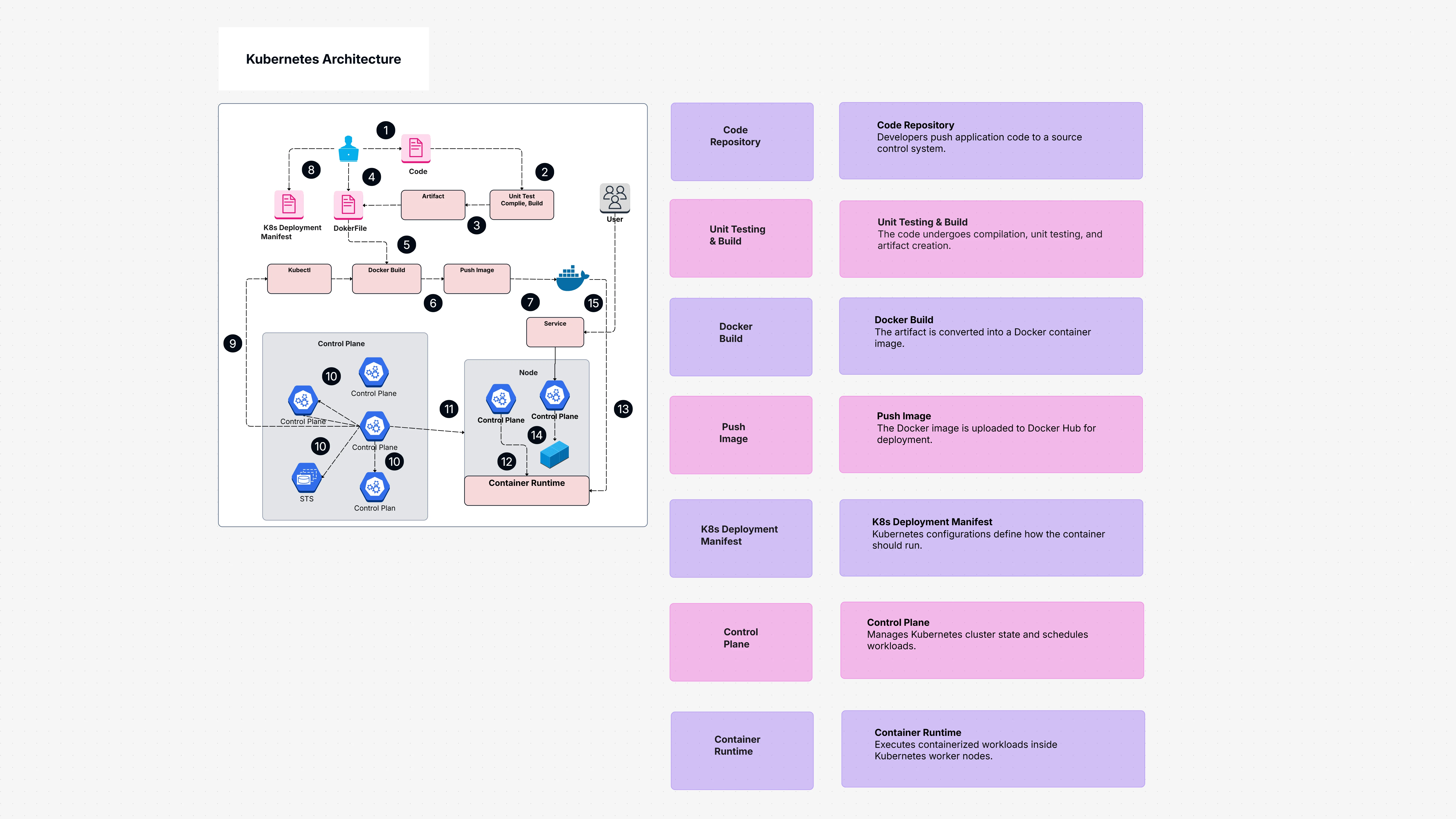
Kubernetes Architecture Template

Cloudairy
 Copy link

Get your team started in minutes
Sign up with your work email for seamless collaboration.
Whiteboard
Copy link

Visualize your container orchestration setup with this Kubernetes Architecture Template. Simplify deployment, scaling, and management of applications.
Visualize your container orchestration setup with this Kubernetes Architecture Template. Simplify deployment, scaling, and management of applications.
The Kubernetes Architecture Template provides an organized, easy way to visualize and design your Kubernetes environment. The aspects included in this template are the control plane (the "brains" orchestrating everything!), the container runtime (where your applications are born), and developer interactions with Kubernetes (like using kubectl!). It also shows you the complete process of building and managing your application images (using Docker, Docker Hub, and unit testing).
This template is a fantastic tool for teams, those using Kubernetes to build, manage, and deploy their containerized applications. This is simply a model to support simplifying Kubernetes for building systems that are flexible, reliable, and efficient. Finally, this model makes it easy to create these diagrams for important Kubernetes architecture.
Jumpstart your journey with these 6 easy steps:
Ready to get started designing? Here’s how you can use Cloudairy with this template:
Here are the main parts you'll see in your Kubernetes setup diagram:
Control Plane (The Brains!)
API Server: Handles all the chatter between Kubernetes parts and is where you send your kubectl commands.
Controller Manager: Ensures your cluster remains exactly how you desire, continually monitoring and remedying issues.
Scheduler: Determines what "pods" (your app's tiny containers) go where in the "nodes" (your machines), based on what they are requesting.
Etcd: A distributed database that keeps track of the state of your cluster and settings..
Worker Nodes (The Muscle!)
Kubelet: This agent runs on each machine and makes sure your containers are up and running in their pods.
Kube-Proxy: Handles all the networking and load balancing inside your cluster, like a traffic cop for your apps.
Container Runtime (Where Apps Live!)
Docker or Containerd: This is the engine that actually runs your containers on your worker machines and manages their lives.
Developer Workflows (How You Work!)
Kubectl: Your reliable command-line application for interfacing with and controlling your Kubernetes clusters and applications.
Docker Build: How you produce those wonderful container images for your applications.
Push to Docker Hub: Where to send your completed container images for easy storage and sharing.
Unit Testing: Ensuring your app works properly before deploying it..
Workflow Steps: How It All Happens!
Here's a simple look at the steps:
Get a super clear picture of your Kubernetes setup with this easy-to-use template! Cloudairy lets you efficiently design, visualize, and manage your Kubernetes deployments. Create easy-to-understand Kubernetes architecture flowcharts that show the control plane, container runtime, and how developers work. This template covers all the essentials of container orchestration diagrams, making it simpler to streamline your application deployment and management for your entire cluster setup! Discover efficient Kubernetes scaling powered by Amazon Web Services and Karpenter.
Loading subcategories...
 Manage all your work in one place
Collaborate with your team
Use Cloudairy for FREE—forever
Explore More