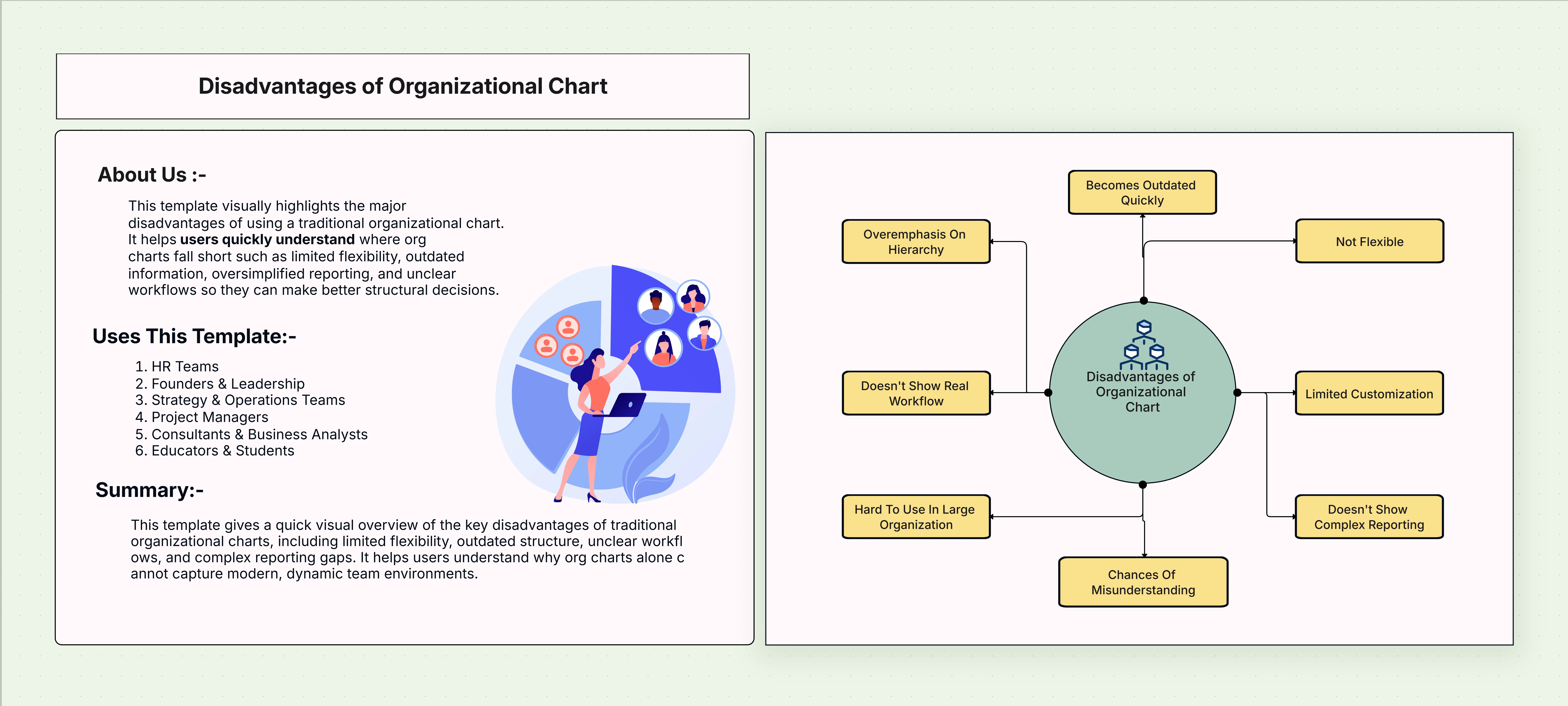
Disadvantages of Organizational Chart Template

Cloudairy
 Copy link

Get your team started in minutes
Sign up with your work email for seamless collaboration.
Whiteboard
Copy link

Explore the disadvantages of organizational charts with this template. Identify structural limitations, communication gaps, role rigidity, and hierarchy challenges to better understand their impact on your organization.
Explore the disadvantages of organizational charts with this template. Identify structural limitations, communication gaps, role rigidity, and hierarchy challenges to better understand their impact on your organization.
This template gives a systematic method to point out and show the possible limitations of organizational charts. Though charts provide understanding, at the same time they also bring about rigidity, oversimplification, and less visibility across functions. This template facilitates teams to consider these limitations in order to create more adaptable structures and enhance interaction. It is particularly beneficial for development, consultancy, and strategic alignment meetings. To compare the benefits, go to the Advantages of Organizational Chart Template.
This template is structural rigidity, communication gaps, role oversimplification, outdated hierarchy issues, and hidden workflow challenges, helping teams evaluate limitations and improve organizational clarity, flexibility, and collaboration.
Organizational charts can create rigid reporting lines that discourage collaboration and limit innovation. This template helps teams examine where structure may restrict adaptability or create dependencies that slow decision processes. It is especially valuable during restructuring or rapid growth. For additional context on hierarchy models, see the Organizational Chart Template.
Many roles involve cross-functional duties that are not visible in a standard chart. This template highlights how oversimplification can lead to misunderstandings, unclear workloads, and unrealistic expectations. It encourages teams to map responsibilities more accurately. For supporting insights, refer to the Organizational Structure vs Organizational Chart Blog.
Because organizational charts primarily depict hierarchy, they often fail to show lateral communication patterns. This template helps identify communication blind spots that affect projects, cross-team coordination, and collaboration. It is useful for operations and project teams evaluating workflow issues. Learn more about communication clarity in the How to Create an Organizational Chart Guide.
Modern roles evolve frequently, and static charts rarely keep up. This template encourages teams to assess where outdated charts may create confusion or misalignment. It helps leaders plan updates and ensure documentation stays relevant. For industry-specific variations, explore the Industry Organizational Chart Examples.
Charts can unintentionally strengthen top-down control or reduce collaboration if not designed thoughtfully. This template supports discussions on balance, empowerment, and flatter communication models. It’s useful for HR, leadership planning, and culture transformation initiatives. For related organizational insights, visit the Purpose of Organizational Chart Template.
This template supports HR, leadership, consultants, and operations teams by identifying structural issues, communication gaps, and workflow barriers, helping organizations improve clarity, redesign hierarchy, and strengthen cross-team collaboration.
HR teams use this template to highlight structural limitations during planning, restructuring, and leadership alignment sessions. It helps them identify departmental silos, rigid reporting lines, and unclear responsibilities. This template is also valuable for cultural assessments. Pair it with the HR Organizational Chart Template for a broader understanding of structural dynamics.
Executives use this template to explore how hierarchy may be affecting communication and performance. It supports strategic planning conversations and leadership workshops, especially during growth or transformation. For reviewing both benefits and limitations, refer to the Advantages and Disadvantages Blog.
Consultants rely on this template to uncover issues within client structures, from slow decision-making to misaligned responsibilities. It helps guide redesigns, workflow improvements, and cultural transformations. This resource complements the Purpose of Organizational Chart Template in advisory settings.
Operations and project managers use this template to identify communication gaps and bottlenecks caused by rigid structures. It helps teams map collaboration problems that affect timelines, stakeholder alignment, and cross-functional work. To compare operational needs, explore the Project Organizational Chart Template.
This template helps teams identify structural weaknesses, communication barriers, and hierarchy issues, making it valuable for planning, restructuring, training, and improving organizational design across departments and industries.
The Disadvantages of Organizational Chart Template is a very important tool for groups that are considering organizational structure problems. This tool is able to spot areas where communication is lacking, problems with the rigidities of the hierarchy, old or oversimplified responsibilities. Regardless of whether the template is used by HR leaders, consultants, or project teams, it gets organizations to reconsider the impact of structure on performance. It enables open-minded, joining forces, and quick response planning in all sectors.
This template is ideal for HR teams, consultants, leadership groups, and operations managers who need to analyze and address organizational structure limitations. To explore benefits alongside limitations, see the Advantages Template.
It highlights hierarchy rigidity, communication barriers, outdated structure designs, unclear responsibilities, and missing links in cross-team workflows. To understand how structures differ, visit the Organizational Structure vs Organizational Chart Blog.
Yes. It helps teams discuss and diagnose structural issues before making redesign decisions. It is widely used during organizational transformations. For strategic planning templates, explore the Purpose of Organizational Chart Template.
Absolutely. It is often used in leadership development, HR training, and team workshops to help employees understand common structural challenges. For additional onboarding resources, see the Functional Organizational Chart Template.
The Advantages Template highlights benefits of org charts such as clarity and communication flow, while this template focuses on structural limitations. For comparison and deeper analysis, refer to the Advantages and Disadvantages Blog.
Loading subcategories...
 Manage all your work in one place
Collaborate with your team
Use Cloudairy for FREE—forever
Explore More