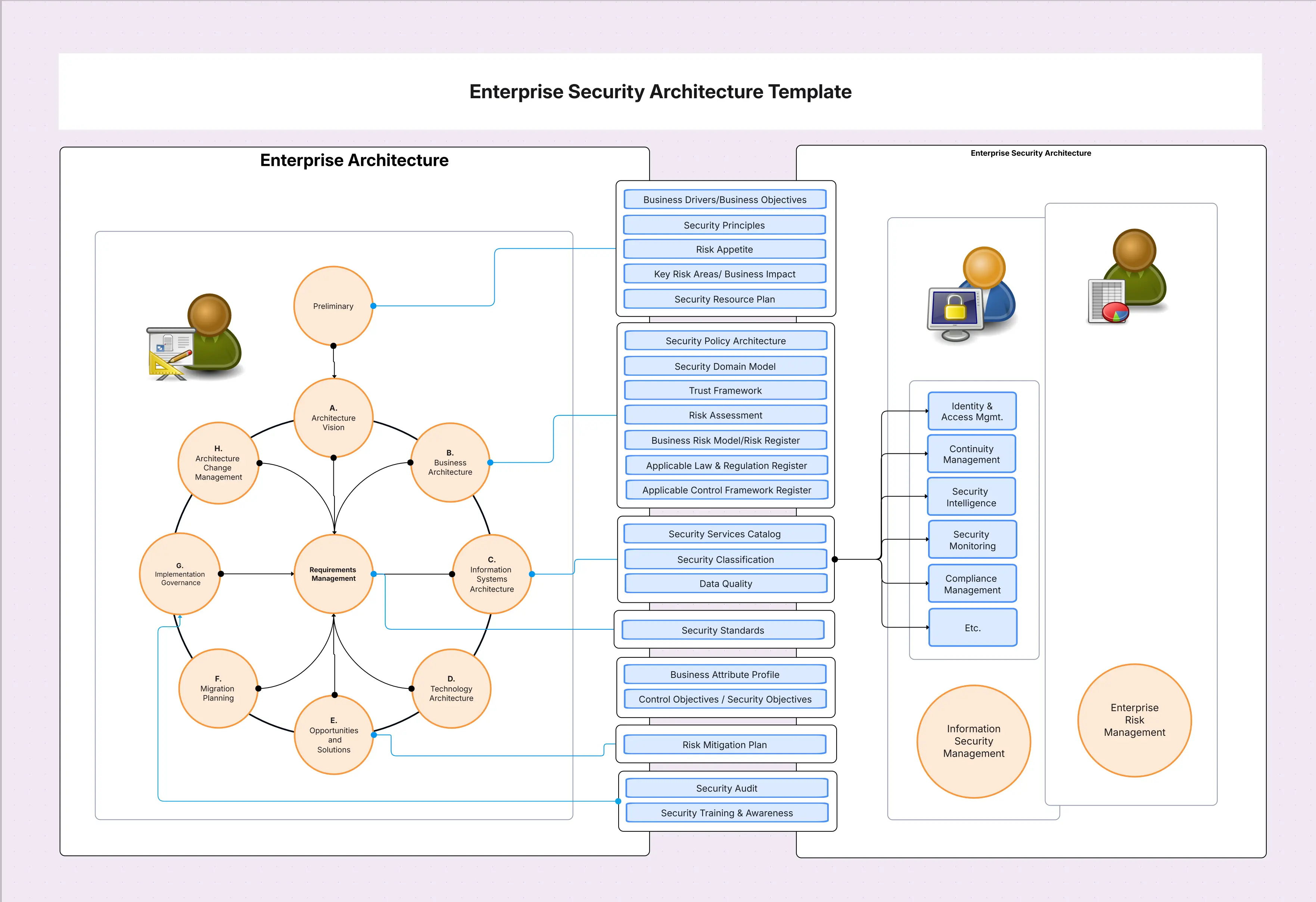
What is an Enterprise Security Architecture Template?
An enterprise security architecture template is a practical blueprint for translating policies and risk objectives into working security capabilities across your organization. It connects strategy with day-to-day controls, showing how identity, networks, applications, and data protections work together. Rather than scattered documents, you get one source of truth that aligns technology with governance and business goals. Use it to brief leadership, coordinate teams, and anchor audits with a clear, defensible model of your environment.
Key Components of Enterprise Security Architecture (SABSA & TOGAF)
A strong and well-considered enterprise security architecture spans people, process, and technology, yet it truly works only when absolutely tied to real business drivers and tangible measurable risk reduction. This section organizes the model into policy, platform, and runtime layers that you can trace back to requirements. By mapping capabilities to enterprise security models, you can prove coverage, spot overlaps, and prioritize improvements. The goal is a living architecture: understandable to stakeholders, testable by engineers, and auditable by regulators.
See below for what’s included in this enterprise security architecture template:
- Governance & Risk Alignment: Map relevant business requirements to company policies, standards, and control objectives that truly matter. Show how identified risks translate into concrete operational guardrails and natural review cadences across diverse teams. Tie board-level concerns to measurement metrics that engineers can confidently implement and auditors can reliably verify, ensuring full traceability end to end.
- Identity & Access Architecture (IAM): Clearly define practical role models, federation patterns, and privilege boundaries across multiple apps and services our people use. Include streamlined joiner-mover-leaver flows and straightforward emergency access processes with detailed logging. Link to our preferred IAM Architecture Diagram Template and Zero Trust Architecture Template to help teams visualize continuous hands-on verification.
- Data Security & Privacy Controls: Classify sensitive data, map realistic residency locations, and define encryption at rest, in transit, and in active use for our operations. Model well-structured key management, tokenization, and retention with proper legal bases. Show lineage into analytics platforms and DLP boundaries so compliance teams can easily validate obligations.
- Network & Perimeter Segmentation: Illustrate logical zones, thoughtful micro-segmentation, and secure connectivity patterns trusted by our organization. Model service egress, API gateways, and strong inspection points for east-west and north-south traffic flow. Cross-reference our Network Security Architecture Diagram for packet-path clarity that engineers understand.
- Application & Platform Security: Capture SDLC controls, smart secrets management, and realistic runtime hardening steps. Include SAST/DAST/SCA checks, signing processes, and container policies mapped to live environments. Link build to deploy with tangible evidence, then surface security posture in dashboards for teams and auditors to review.
- Monitoring, Detection & Response: Place SIEM, EDR, and telemetry across all endpoints, cloud systems, and identity layers we maintain. Show logical alert flows, clear playbooks, and containment paths for major threats. Connect with our Security Monitoring Architecture Template to ensure incident readiness every time.
Enterprise Security Models (SABSA)
The SABSA enterprise security model helps you start with business attributes—like confidentiality, availability, and trust—and trace them to technology controls. Its layered viewpoints keep conversations grounded: from contextual strategy to operational procedures. In practice, SABSA avoids tool-first decisions by forcing a “why” before “what,” which plays nicely with agile delivery. Use SABSA here to frame your capability map, prioritize outcomes, and anchor governance reviews that actually drive measurable risk reduction.
See below for how SABSA maps within this security architecture framework:
- Contextual & Conceptual Layers: Capture mission goals, risk appetite, and attribute profiles.
Translate narratives into measurable qualities and policy intents.
These become the reference points that keep architecture choices aligned when roadmaps shift.
- Logical & Physical Layers: Clearly define essential services, trust zones, and information flows within your business context. Then bind them carefully to concrete platforms, existing controls, and seamless integrations. This is the stage where abstract requirements genuinely turn into practical designs that engineers can build and confidently test.
- Component & Operational Layers: Specify chosen products, detailed configurations, and daily operational procedures for your team. Document complete runbooks, KPIs, and proper evidence capture for smooth audits. Use the Security Architecture Diagram Tool thoughtfully to keep all these artifacts consistent, collaborative, and easy to share across departments.
Enterprise Security Framework (TOGAF)
Using TOGAF for enterprise security architecture brings discipline to road-mapping and change management. You can run the ADM cycle to evolve capabilities without breaking today’s operations. Security threads are woven into business, data, application, and technology architectures, so your roadmap respects dependencies and budget. Pair TOGAF’s governance cadence with SABSA’s attribute-driven views, and you get both direction and detail: why it matters, how it’s designed, and when it ships—without losing auditability.
See below for how TOGAF supports this enterprise security framework:
- ADM & Governance: Establish phases, gates, and decision records.
Track architecture debt and risk exceptions with transparent ownership.
This creates predictable progress that leadership can fund and teams can deliver.
- Reference Models & Building Blocks: Reuse patterns for IAM, logging, and integration.
Snap components into solutions while preserving standards.
Reduce cycle time by publishing versioned blueprints teams can adopt quickly.
- Portfolio & Roadmap Management: Align initiatives with cost, risk, and dependency views.
Sequence changes so critical controls land first without blocking delivery.
Link to
- Enterprise Security Frameworks: SABSA vs TOGAF for deeper comparisons.
When to Use an Enterprise Security Architecture Template
An enterprise security architecture template shines when your organization needs a shared picture of how security supports business outcomes. Use it to align programs after mergers, scale controls in fast-growing teams, or untangle overlapping tools. It’s also invaluable before audits and while onboarding new platforms. By standardizing patterns and responsibilities, you reduce friction, speed delivery, and give stakeholders a confident, consistent view of risk posture across the enterprise.
See below for the best moments to deploy this enterprise security model template:
- Migrations, Mergers, and Re-platforming: Normalize shared policies and advanced controls across inherited systems in detail. Expose system gaps early where possible, then phase remediation carefully with less business disruption. Link visible results
directly back to risk reduction and enhanced service reliability for executive teams.
- Compliance Uplift or Certification: Prove audit coverage for SOC 2, ISO 27001, or definite industry mandates confidently. Map defined evidence sources to internal controls and fully automate the collection tasks. Point compliance reviewers directly to unified architecture views instead of messy spreadsheets.
- Zero Trust & Identity-First Programs: Redesign critical trust boundaries and enforce continuous verification holistically. Roll out least-privilege and context-aware access systems at enterprise scale. Cross-reference the practical Zero Trust Architecture Template for cohesive end-to-end implementations.
- Cloud & Hybrid Expansion: Standardize clear operational patterns across global regions and multiple providers. Codify segmentation, encryption, and logging baselines for stronger governance policies. Deep-link insights to the Cloud Security Architecture Diagram Template for environment-specific context.
How to Customize Your Enterprise Security Architecture Design
A reusable security architecture design should still feel handcrafted to your environment. First, take into account your unique risk profile and the specific regulatory framework you operate under, and adjust capabilities where they add the most value. When creating diagrams, aim for clarity—include only the essential information that enables sound decision-making while keeping complexity in check. Structure your model versions alongside existing policies and reference designs to ensure that any change is consistently reflected, helping your team fully trust the system they’re building.
See below for tailoring this enterprise security architecture template:
- Anchor to Business Attributes: Establish your organisation’s priorities for confidentiality, integrity, availability, and privacy.Translate these into well-documented policies, quantifiable metrics, and structured architectural checks.Maintaining this structure ensures all trade-offs are acknowledged when deadlines become tight.
- Fit Your Operating Model: Align processes to centralized, federated, or product-team ownership as appropriate.Define formal decision rights, escalation procedures, and consistent review schedules.Such precision prevents bottlenecks and policy stalemates before they occur.
- Map Control Ownership & Evidence: Assign ownership for each control along with its verified data source.Implement log automation to evidence repositories in line with retention policies.Utilise the Security Architecture Diagram Tool to embed references to runbooks and monitoring dashboards.
- Integrate IAM & Network Baselines: Combine least-privilege with segmentation tiers.
Document default patterns teams can copy safely.
Reference Network Security Architecture and IAM Template for consistency.
- Operationalize Detection & Response: Place sensors where attacks actually happen.
Define playbooks with RTO/RPO targets and test frequency.
Tie incidents back to architecture risks to drive improvements.
Example Use Cases for Enterprise Security Architecture
A well-structured enterprise cyber security architecture brings order to complex environments. It clarifies how products accommodate, how teams collaborate, and how risks are handled before they escalate. Whether you’re a digital-native startup maturing controls or an established enterprise modernizing platforms, a common architectural language accelerates progress and reduces surprises—especially during audits, outages, or leadership change.
See below for real-world applications of this security architecture framework:
- Payment Platform Modernization: Harmonize PCI DSS controls across microservices.
Codify encryption, key management, and tokenization.
Prove end-to-end traceability from policies to production flows.
- Global Workforce & SSO Expansion: Introduce identity federation and device trust.
Stage rollouts by risk and criticality with fallback paths.
Pair with Identity Federation & SSO Diagram for cross-tenant clarity.
- Regulated Data Analytics: Secure data pipelines with lineage, masking, and audit.
Align residency and retention with legal requirements.
Connect posture to Security Monitoring Architecture for continuous assurance.
- Multi-Cloud Platform Engineering: Standardize patterns across AWS, Azure, and GCP.
Enforce shared controls via platform blueprints.
Reference Cloud Security Architecture Diagram for provider-specific details.
FAQs
1. What makes an enterprise security architecture “enterprise-grade”?
Enterprise-grade means the architecture ties business risks to enforceable controls, scales across teams and platforms, and produces evidence for audits. It prioritizes clarity, ownership, and measurable outcomes over tool checklists.
2. How do SABSA and TOGAF work together in practice?
From my own experience, SABSA focuses on why we’re doing something and what exactly needs to be achieved, using business attributes as a solid foundation. TOGAF, on the other hand, takes care of how and when things should happen, offering administration structures and well-designed roadmaps. When paired, they ensure objectives stay aligned and work progresses smoothly in a predictable rhythm. See SABSA vs TOGAF.
3. Can this template reduce audit fatigue?
Yes. By mapping controls to owners, evidence sources, and dashboards, auditors follow one model instead of chasing documents. The Security Architecture Diagram Tool centralizes views and links.
4. How do we keep the model current as systems change?
Version it like code. Tie updates to change reviews and CI/CD events, and require updates when introducing new platforms. Publish views in team portals so drift is visible and actionable.
5. Where should we start if our environment is messy?
Begin with a slim, high-value slice: identity, network boundaries, and logging. Prove value quickly, then expand to data and application layers. Use the Pillar Guide to prioritize next steps.

 Copy link


 Manage all your work in one place