Get your team started in minutes
Sign up with your work email for seamless collaboration.
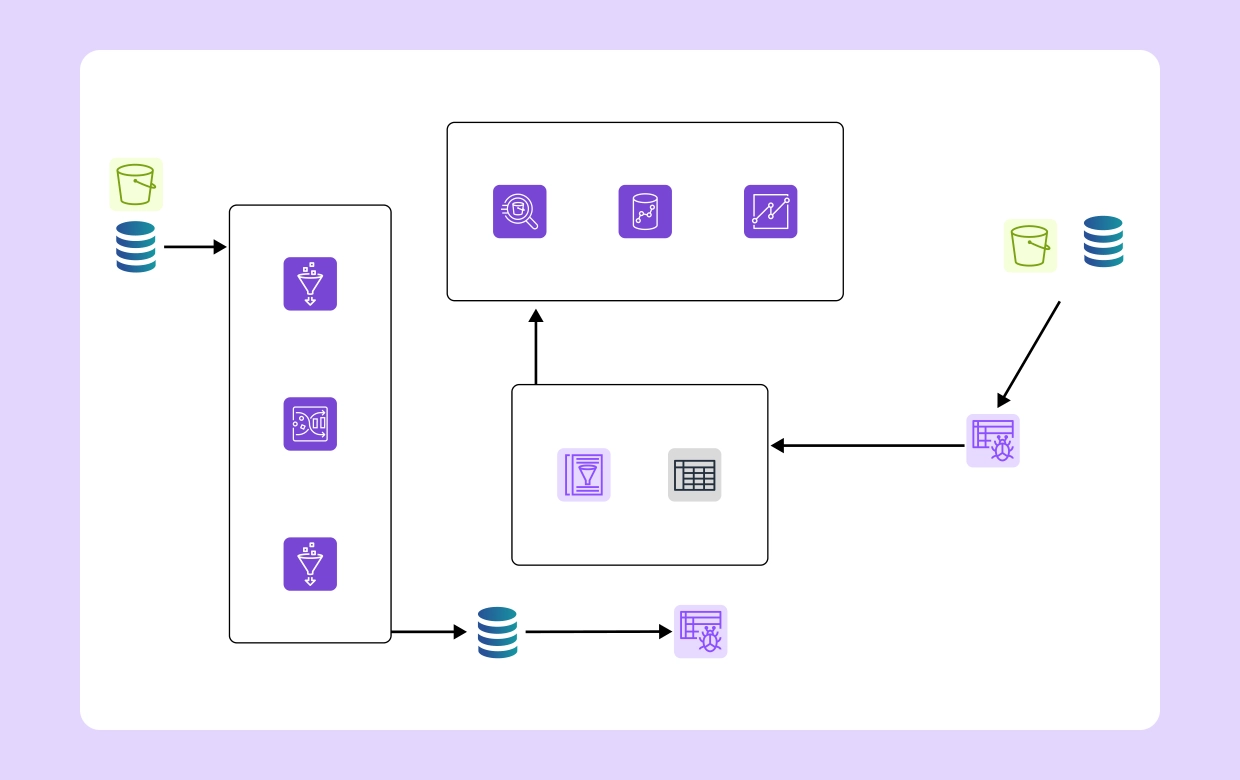
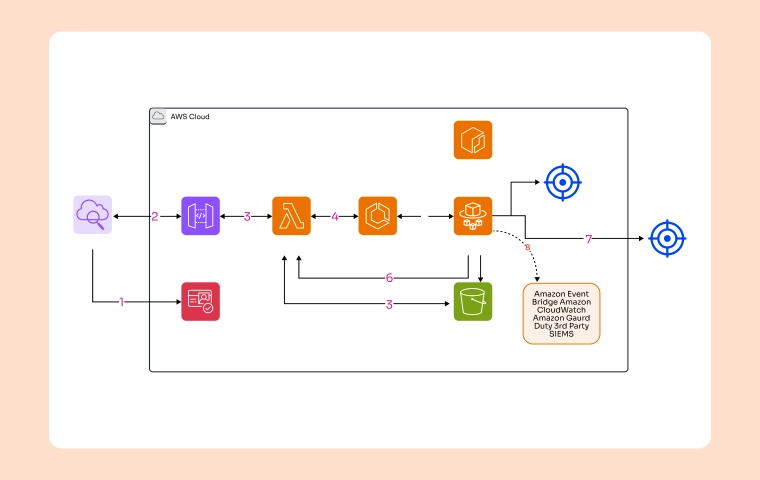
Data integration and ETL (Extract, Transform, Load) tasks can be complex, especially when working with massive datasets. AWS Glue, Amazon’s managed ETL service, simplifies the process, enabling users to prepare data for querying using other AWS services such as EMR or Redshift. However, optimizing the architecture design for data pipelines is crucial to unlocking AWS Glue's full potential. In this blog, we will explore how Cloudairy’s Cloudchart a powerful tool for designing cloud architecture can enhance how you build, visualize, and collaborate on your AWS Glue projects.
AWS Glue provides numerous features that make it highly effective for handling complex data integration tasks. These features are designed to automate various aspects of the ETL process, reducing manual effort while ensuring scalability and flexibility.
At the heart of AWS Glue is the Data Catalog, a centralized repository for metadata. It stores information about data tables, partitions, schemas, and transformation processes, making it an indispensable component of the ETL workflow.
The Data Catalog automatically registers partitions, tracks schema changes over time, and retains control information, enabling smooth data transformations.
A well maintained Data Catalog ensures that AWS Glue can efficiently query and transform data without requiring extensive manual intervention. As your data environment evolves, the Data Catalog helps keep track of these changes, maintaining continuity across your pipelines.
One of AWS Glue’s standout features is automatic ETL code generation. Users can specify the data source and destination, and AWS Glue will automatically generate the code needed to move and transform that data.
This code, written in either Python or Scala, is optimized for Apache Spark, ensuring that even heavy workloads are efficiently parallelized.
This automatic generation feature is a game-changer for teams looking to minimize the time spent on coding. It allows them to focus on higher-level tasks like optimizing the ETL process. The generated code also allows for customization, giving users the flexibility to fine tune their transformations as needed.
AWS Glue also simplifies data schema recognition through the use of crawlers. Crawlers explore data sources and automatically identify their schemas, eliminating the need for users to manually define complex schema configurations.
Once a schema is recognized, the crawler saves the metadata into the Data Catalog, allowing seamless integration into the ETL pipeline.
This feature is handy when dealing with heterogeneous data sources, as the crawler adapts to various file formats, databases, and streaming data sources. With schema recognition, AWS Glue ensures that all data is accurately mapped and available for transformation.
Data crawlers are the backbone of AWS Glue’s metadata collection system. They autonomously crawl through data repositories and determine the most appropriate schema for each dataset.
Once identified, the schema is stored in the Data Catalog, providing a reference for future ETL jobs.
Additionally, classifiers help the crawler identify the data's format, ensuring that the right schema is applied. Whether you’re working with structured, semi-structured, or unstructured data, crawlers and classifiers ensure that your data is properly categorized and ready for processing.
The Glue AWS Console is the management interface through which users control all aspects of their ETL jobs. It allows users to define data jobs, create connections to various data sources, set up schedules, and configure event-driven triggers for ETL processes.
The AWS console also allows you to edit transformation scripts, manage tables and metadata, and search for data objects. This intuitive interface streamlines the process of configuring and managing ETL pipelines, making it easier for users to stay organized and efficient.
AWS Glue includes a robust job scheduling system that allows users to automate the execution of their ETL jobs. You can schedule jobs to run at specific intervals or use event-driven triggers to launch jobs when certain conditions are met.
The job scheduling system also supports chaining ETL pipelines, enabling more complex workflows to be executed sequentially or parallelly. By automating the scheduling process, AWS Glue ensures that data transformations occur on time and as planned.
AWS Glue’s ETL Operations component automatically generates Python or Scala code for your ETL workflows. This generated code can be customized to fit specific use cases, giving you complete control over the transformations applied to your data.
The code integrates seamlessly with Apache Spark, allowing it to handle large-scale data operations in parallel, optimizing performance for even the most demanding workloads.
AWS Glue is a powerful ETL service that automates the data integration process. Still, its efficiency and scalability largely depend on how well you design the underlying data architecture. Here are the key reasons why thoughtful data architecture design is essential for AWS Glue:
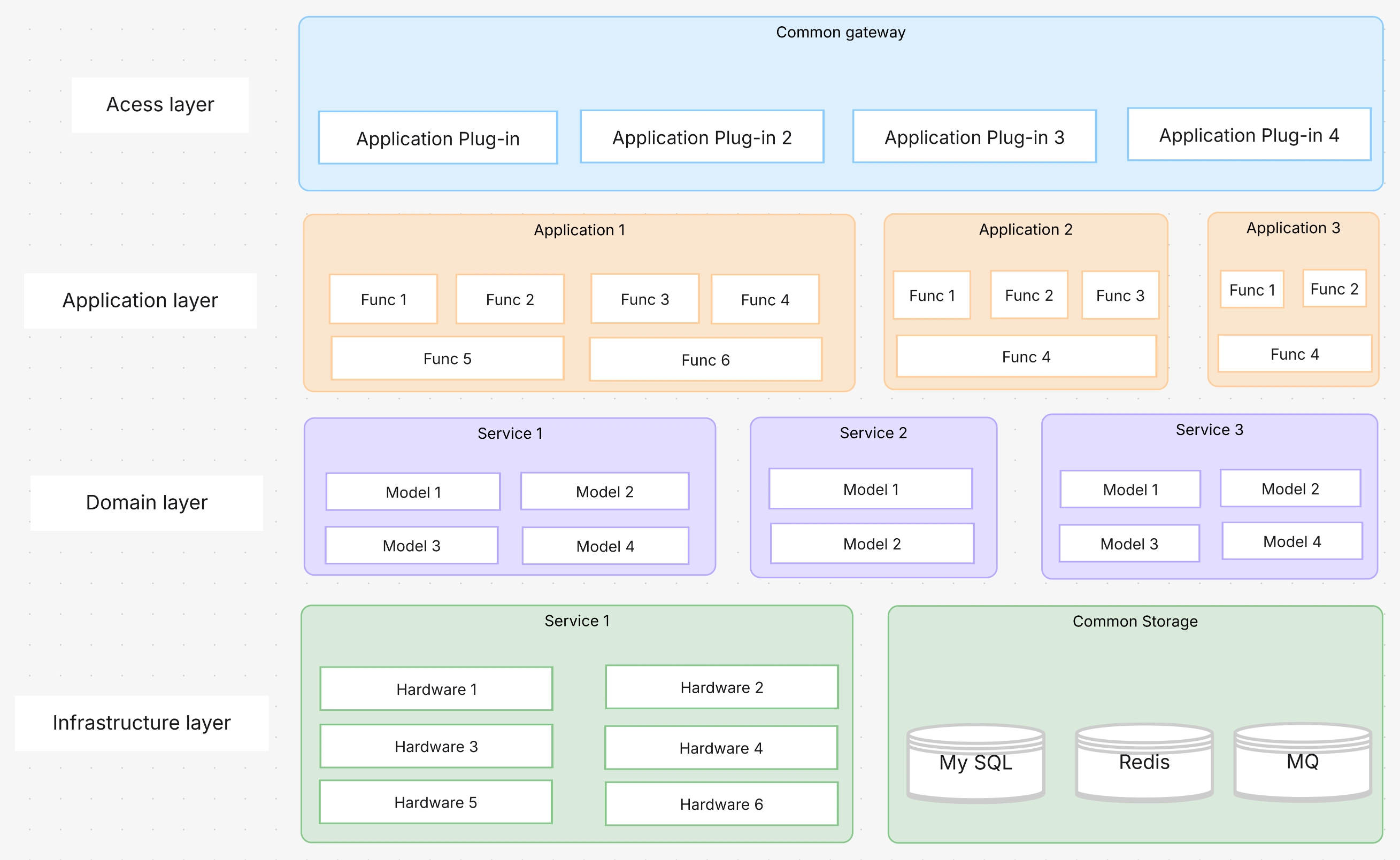
A well designed data architecture helps optimize the performance of your AWS Glue ETL pipelines. Efficiently structuring data flows diagram, transformation steps, and resource management minimizes bottlenecks. Poorly designed architectures can result in slow performance, excessive resource usage, and higher costs.
AWS Glue is built to handle large-scale data processing tasks, but scalability depends on the data architecture you implement. By carefully planning your architecture organizing data partitions, optimizing joins, and handling schema evolution you can ensure that your ETL processes scale seamlessly with growing data volumes.
AWS Glue operates on a pay-as-you-go pricing model, where you are charged for the computing resources you use. A well-architected data solution can minimize unnecessary resource consumption. By reducing redundant data transformations, avoiding inefficient queries, and optimizing job execution, you can lower your costs significantly.
Modern data environments often involve complex workflows, including batch and real-time data processing. AWS Glue can handle these tasks only if the architecture is designed to accommodate these complexities. A robust architecture ensures that batch processing and streaming data integration are handled separately and efficiently, reducing errors and ensuring data consistency.
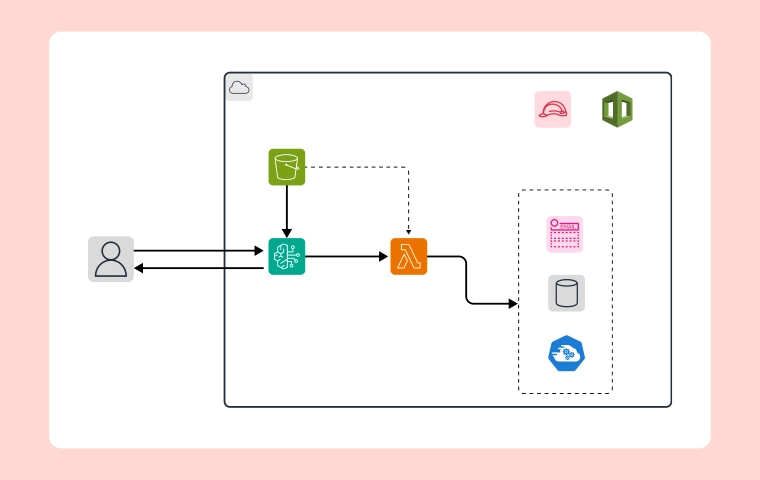
AWS Glue integrates seamlessly with other AWS services like Amazon S3, Redshift, and Kinesis, but proper architectural design is critical to leverage these integrations effectively. A well designed architecture ensures smooth data flows between these services, enhancing the overall functionality of your data pipelines.
With increasing focus on data governance and compliance, it is essential to design architectures that allow for easy data tracking, auditing, and management. AWS Glue supports features like AWS glue data catalogs and data versioning. Still, these features must be implemented through a sound architectural plan to maintain data integrity and adhere to regulatory requirements.
Failures in ETL jobs are inevitable, but how you design the data architecture determines the ease of recovery. A strong design ensures robust error handling, automatic retries, and efficient logging, enabling AWS Glue to recover from failures without disrupting workflows. Poorly designed architectures can lead to frequent job failures and data consistency.
AWS Glue allows for fine-grained access control through AWS Identity and Access Management (IAM) policies, but designing a secure data architecture is crucial for maintaining security. By planning roles, permissions, and data encryption strategies upfront, you can ensure that sensitive data is protected and that only authorized users have access.
A good data architecture is built with future scalability in mind. Adopting a flexible design that can accommodate new data sources, evolving schemas, and changing business requirements ensures that your AWS Glue setup remains adaptable to future needs without requiring a complete overhaul.
Here are the pros and cons overview:
Hence, its pros and cons stand out in light of how great AWS Glue is for large scale, serverless ETL jobs, but it also shows some significant challenges it might have, mainly for smaller or highly customized workflows.
Cloudairy Cloudchart is designed to create serverless architecture, particularly for AWS Glue. While it helps streamline the design and collaboration phases, its purpose isn't optimization but enhancing how architecture is visualized and built. The standout feature, Generative AI Magic, enables users to describe their ideas in detail and instantly generate precise flowcharts, drastically reducing the time needed during the design phase of AWS Glue pipelines. This allows more focus on refining ETL processes. Another vital feature is real-time collaboration, which allows data engineers, architects, and stakeholders to work together on the same architecture diagram simultaneously, keeping everyone aligned and accelerating project timelines. Cloudchart focuses exclusively on cloud architecture design without handling direct optimizations.
In conclusion, a robust set of tools makes it a must-design AWS Glue architecture. Indeed, the AI-driven flowchart generator and the real-time collaboration functionality help bring complex ETL workflows to life, significantly saving time and eliminating errors.
Start using Cloudairy to design diagrams, documents, and workflows instantly. Harness AI to brainstorm, plan, and build—all in one platform.