Application Security Architecture Template

Cloudairy
 Copy link

Get your team started in minutes
Sign up with your work email for seamless collaboration.
Whiteboard
Copy link

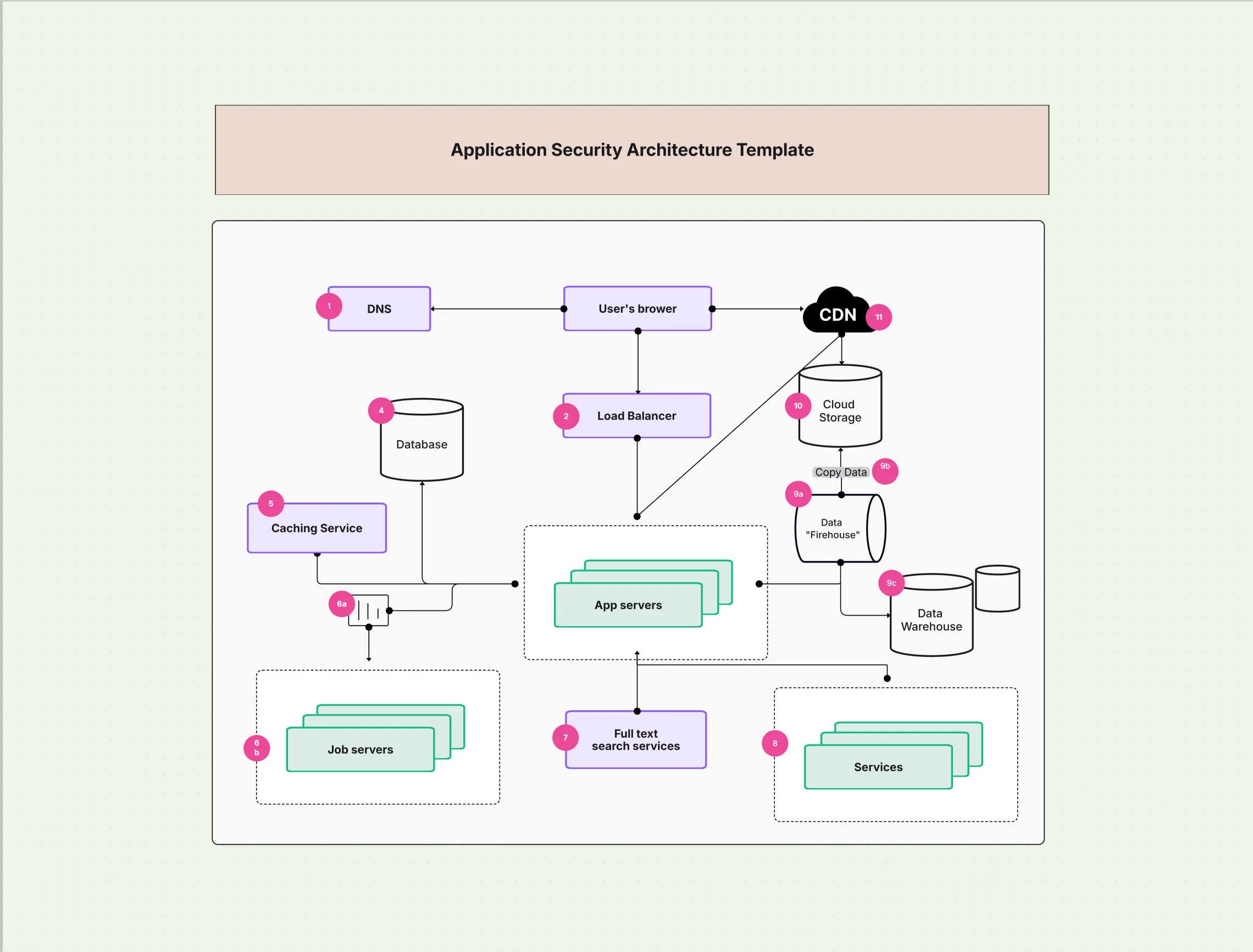
Secure your applications with this Application Security Architecture Template. Visualize layered defenses, security testing, and governance across the entire SDLC to build resilient, compliant, and secure applications from design to deployment.
Secure your applications with this Application Security Architecture Template. Visualize layered defenses, security testing, and governance across the entire SDLC to build resilient, compliant, and secure applications from design to deployment.
A template for Application Security Architecture serves as an overall picture of your application security architecture and serves as a road map by providing a clear, concise, and consistent way for your organization to work together in the development, operations, and security teams. The template embeds security into the entire application development lifecycle by providing a blueprint that enables developers to collaborate across all aspects of the development and operational processes. The template will help organizations to apply the same level of security controls to all applications developed in their environment. In addition, the template provides a graphical representation that depicts the interactions of each of these security controls within an organization's application environment, thus allowing organizations to identify vulnerabilities before they occur, meet security compliance requirements, and deliver a resilient, user-trusted application.
A Strong Application Security Architecture is Multi-Layered and Encompasses Various Technical & Operational Mechanisms that Provide Protection against Evolving Threats. All the Protection Mechanisms Are Not Independently Isolated; They Are Integrated and Linked Together to Enable Prevention, Detection, and Response Functionality to Protect Against Specific Types of Attacks, e.g., Injection Flaws, Privilege Misuse, Data Exposure, etc. The Protective Controls Implemented in the Application Security Architecture Are Aligned with Enterprise Governance and Compliance, Providing Operational Assurance and Business Continuity No Matter Which Hybrid or Multi-Cloud Environment(s) Are Utilized.
See below for what’s included in this application security architecture template:
Multi-Layered Defense is the framework of an application’s security architecture. The Application Security Architectural Model consists of four distinct layers (Presentation, Logic, Data and Runtime) which are independent of one another and collectively provide a holistic means of protecting the application. By providing a separation of concerns, application security teams can eliminate the risk of a single vulnerability ruining their entire application suite (or most of it). Additionally, with multiple layers, there is redundancy in the security controls, thereby blocking bad actors at multiple points prior to actually attacking the application.This model creates an adaptable security shield that covers Web, Mobile and API applications regardless of where they are hosted and built on various infrastructures.
See below for the essential application security layers detailed in this template:
Creating an Application in a Secure Manner Is Only One Half of the Secure Development Process. The Other Half Is Ongoing Maintenance of the Security Layer. This Section Demonstrates How Continuous Testing and Monitoring Work Together with Compliance Frameworks to Provide an Ongoing Level of Protection for the Long Term. The Architecture Offers Automated Scanning, Runtime Telemetry, and Regularly Scheduled Governance Reviews to Ensure That Every Deployment Has Been Validated. Therefore, Each Process Functions As a Living Security Framework That Evolves Alongside Updates, New Dependencies, and Regulatory Changes.
See below for how testing and compliance appear within this architecture:
For any organization that builds or modernizes their digital applications, the Application Security Architecture Template is a must-have. It can be used during the planning, design, and CI/CD Integration phases, but it is especially useful when security must be aligned with the agile delivery model. The diagram allows for the architect to view all of the controls, how they connect to each other, and what policies apply to all of the environments, meaning that there will be no unmanaged or unprotected layers in the stack.
See below for when to use this application security architecture template:
Each organization has a different technological stack, risk appetite, and compliance requirements, therefore the design of the application security architecture of your should also be different. Tailoring guarantees that the chart is a reflection of your business priorities and that it is compatible without any problems with the existing DevOps toolchains. By modifying the parts to correspond to the work processes, you build a security structure that is feasible, can be expanded, and is simple to take care of during continuous delivery cycles.
See below for how to personalize this application security design:
Every organization, that provides digital products ranging from fintech apps to healthcare systems, can benefit from a secure application architecture. It mainly helps the different teams within the organization to communicate in a more efficient way. Not only the engineering and security teams, but also the management and auditors get the benefit of the increased clarity. The use of this visual tool enables the organization to have more consistent regulation implementation, more foreseen risk handling, and more straightforward application of the responsibility at every stage of the apps lifecycle. Explore how to collect and analyze data to gain actionable insights.
See below for practical application security use cases:
1. What is the purpose of an Application Security Architecture Template?
It helps teams design, visualize, and manage layered defenses across the entire SDLC - ensuring consistency, compliance, and resilience against attacks.
2. How does it relate to DevSecOps?
It merges security into agile delivery by automating scans, reviews, and validations at each stage of CI/CD pipelines.
3. Can this align with OWASP ASVS or ISO 27034?
Yes. It maps controls directly to OWASP ASVS, ISO 27034, and NIST 800-53, ensuring full compliance visibility.
4. Is it suitable for cloud-native and API-first apps?
Absolutely. It supports microservice, containerized, and API-driven architectures with adaptive controls across all layers.
5. How can I build this architecture?
You can use the Security Architecture Diagram Tool to select this template, map controls visually, and share designs with stakeholders.
Loading subcategories...
 Manage all your work in one place
Collaborate with your team
Use Cloudairy for FREE—forever
Explore More