Data Flow Architecture Diagram Template

Cloudairy
 Copy link

Get your team started in minutes
Sign up with your work email for seamless collaboration.
Whiteboard
Copy link

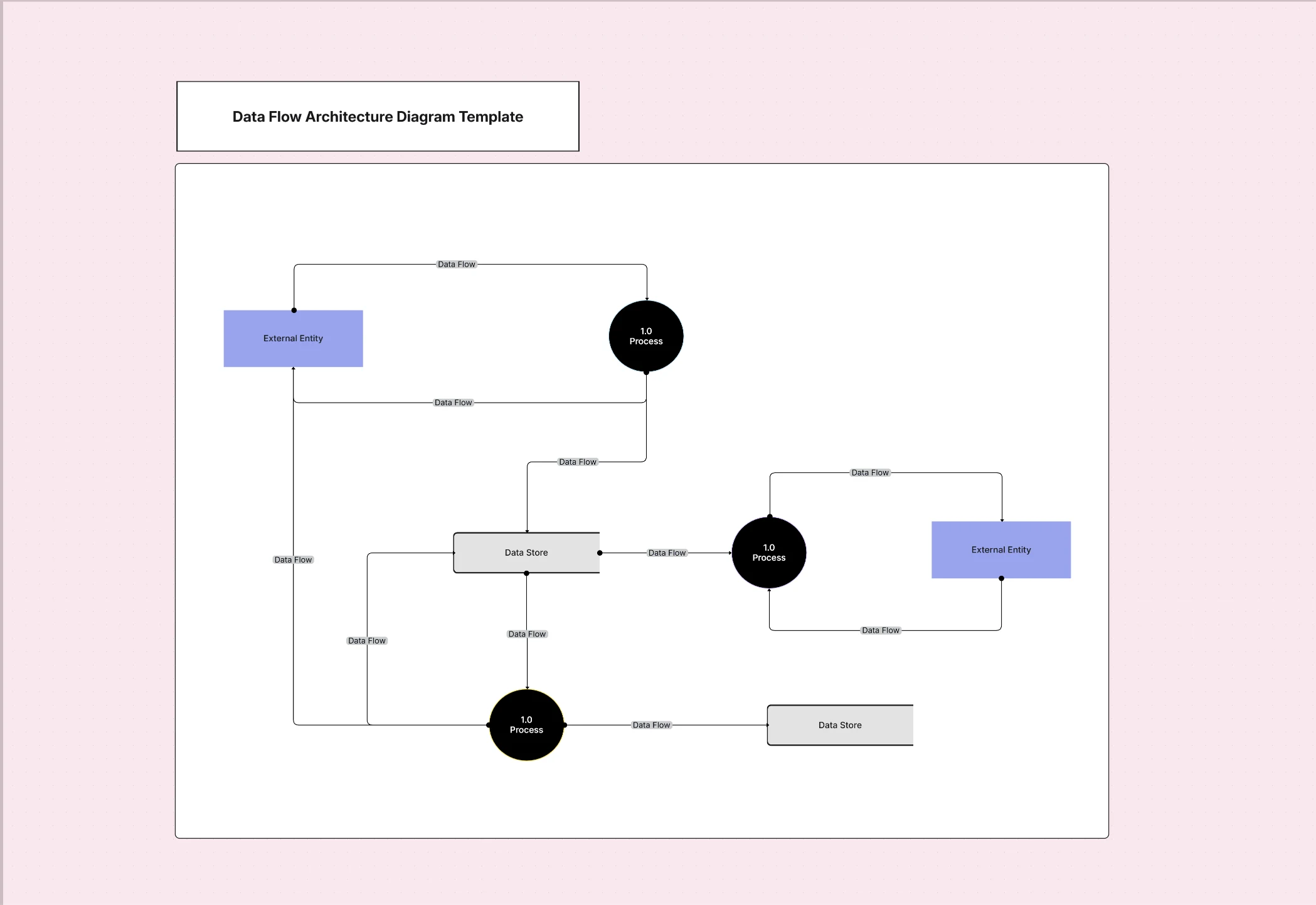
Create a data flow architecture diagram to map ingestion, processing, storage, and analytics. Use this editable template to visualize pipelines, ETL/ELT, and event streams with Cloudchart.
Create a data flow architecture diagram to map ingestion, processing, storage, and analytics. Use this editable template to visualize pipelines, ETL/ELT, and event streams with Cloudchart.
The practical data flow architecture diagram template truly empowers teams to carefully visualize how data is initially captured, subsequently transformed, stored safely, and eventually consumed throughout diverse systems. It prominently highlights the most important sources, pipelines, processing layers, and downstream consumers so stakeholders gain full visibility to completely track lineage and dependencies. By explicitly clarifying the specific roles of producers, transports, and sinks, this robust template helps reduce ambiguity substantially, improve troubleshooting efficiency greatly, and support governance standards effectively that are applicable to analytics, AI/ML, and operational reporting.
See below for what’s included in this comprehensive data flow architecture diagram template.
A data flow architecture diagram organizes every stage of the pipeline from ingestion to analytics into clear, modular sections. This template provides standardized blocks, connectors, and callouts to communicate structure and semantics consistently.
See below for the main elements included in this data flow architecture diagram template.
This specific template is ideal especially when multiple teams actively depend on shared data pipelines or when modernizing analytics frameworks. It provides a truly common language that engineers, analysts, and governance teams all rely on to align expectations and individual responsibilities effectively.
See below, when to use this data flow architecture diagram template.
Cloudchart lets you tailor the data flow architecture template to your stack while keeping diagrams readable. You can layer semantics like freshness, sensitivity, and SLA directly on the canvas.
Here are the steps to customize this data flow architecture diagram template.
Data flow architecture diagrams are widely useful across operational analytics, self-serve BI, and ML platforms. They make dependencies and contracts explicit to reduce pipeline fragility.
See below the examples of how this data flow architecture diagram template can be used.
Explore Azure Landing Zone to build a secure, scalable cloud foundation.
Q1. What is a data flow architecture diagram?
It is a diagram that maps how data moves from sources through ingestion and processing to storage and consumption, including lineage and controls.
Q2. How Does It Differ From a System Architecture Diagram?
A system architecture focuses on components and services, while a data flow architecture diagram emphasizes pipelines, transformations, and data contracts between stages.
Q3. Can This Represent Both Batch and Streaming?
Yes. Use separate connectors and labels to show batch schedules alongside real-time or micro-batch streams within one coherent view.
Q4. Why Use Cloudchart for Data Flow Diagrams?
Cloudchart provides ready blocks, governance overlays, and AI layout assistance, enabling teams to produce accurate, readable pipeline maps quickly.
Loading subcategories...
 Manage all your work in one place
Collaborate with your team
Use Cloudairy for FREE—forever
Explore More