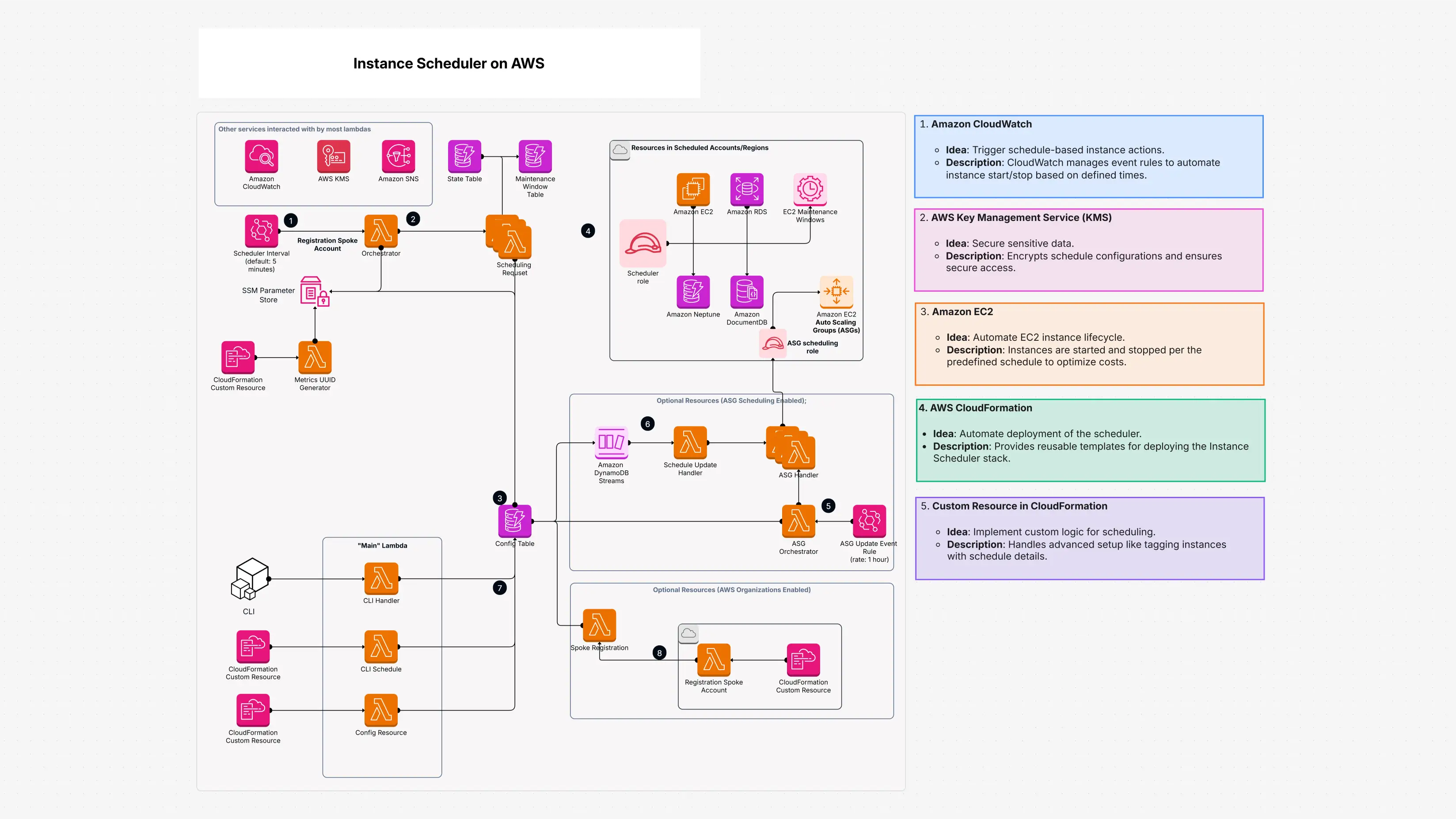
Instance Scheduler on AWS

Cloudairy
 Copy link

AI Workspace for Diagrams & Collaboration
Get your team started in minutes
Sign up with your work email for seamless collaboration.
Whiteboard
Copy link

Use AWS Instance Scheduler to automate EC2 and RDS start/stop schedules, cut cloud costs, and simplify operations. Enable flexible scheduling to optimize resource usage while maintaining performance and operational efficiency.
Use AWS Instance Scheduler to automate EC2 and RDS start/stop schedules, cut cloud costs, and simplify operations. Enable flexible scheduling to optimize resource usage while maintaining performance and operational efficiency.
Based on a timetable, the Instance Scheduler on AWS template is a ready-to-use setup that turns your EC2 and RDS instances on and off automatically. You can, for instance, limit your instances to operating only during your working hours, Monday to Friday, 9 AM to 6 PM.
Every day, you do not need to physically stop or start them. Using AWS resources such as Lambda, CloudWatch, and DynamoDB, the template completes it for you.
Because of the following reason:
You can still use this template with a bit of customisation, even if you are not technically knowledgeable.
Anyone using EC2 or RDS instances frequently will find this template useful. It fits perfectly for:
Now is the perfect moment to apply this template; the longer your resources run when they are not required, the more you spend.
Several AWS services working together are used in this template. Each component of performs thus:
These tools combine to ensure your resources are working when you need them and are stopped when you don't.
Setting up Cloudairy is not difficult; simply:
Once you start the template:
Even if you're not a specialist, Cloudairy lets you view the whole arrangement clearly so you can control it without stress.
A straightforward and intelligent means of managing when your EC2 and RDS instances are active is the AWS Instance Scheduler. It saves money, minimises waste, and reduces manual work. Your AWS resources will only operate at the intervals you specify using this template. No longer paying for something not in use or forgetting to end an instance. Though you don't need to be a cloud expert to use it, it interacts with strong AWS services like Lambda, DynamoDB, and CloudWatch. Beginning this template is a fantastic way to find an easy solution to control your cloud resources and lower expenses. Explore automated task management by scheduling jobs for Amazon RDS for PostgreSQL.
Loading subcategories...
 Manage all your work in one place
Collaborate with your team
Use Cloudairy for FREE—forever
Explore More