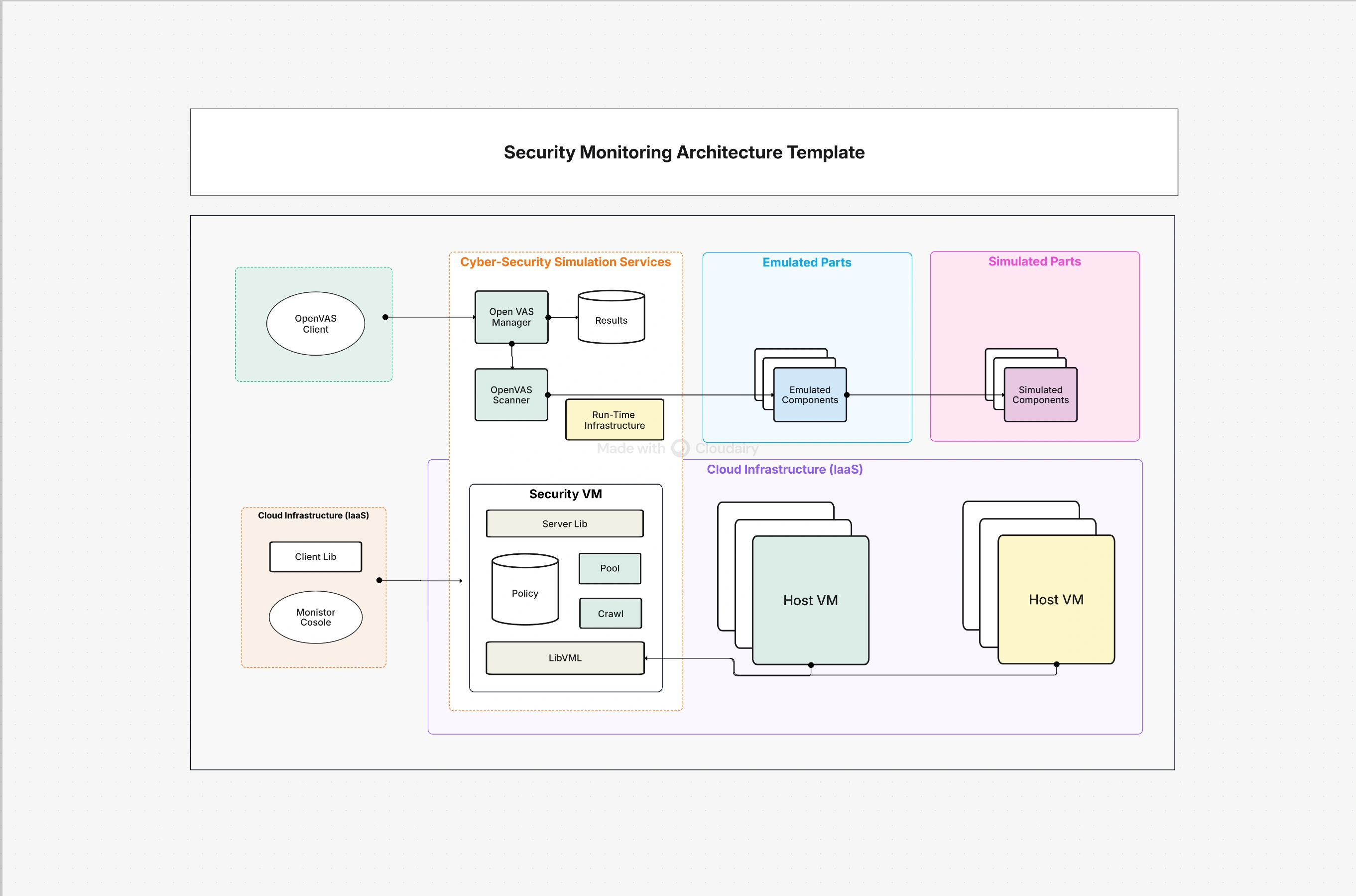
Security Monitoring Architecture Template

Cloudairy
 Copy link

Get your team started in minutes
Sign up with your work email for seamless collaboration.
Whiteboard
Copy link

Build real-time visibility with this Security Monitoring Architecture Template. Map SIEM, SOAR, detection pipelines, and analytics for threat response.
Build real-time visibility with this Security Monitoring Architecture Template. Map SIEM, SOAR, detection pipelines, and analytics for threat response.
A Security Monitoring Architecture Template visually outlines the configuration of in, depth surveillance over a company's whole digital ecosystem. It shows how the security devices, logs, detection tools, and response systems are combined into a single, unified monitoring framework. Such a framework guarantees that every asset, for example, endpoints or APIs, is monitored constantly for any abnormality or violation of regulations. As a result of this mapping of these interactions, the departments have access to quicker detection, relevant insights, and the necessary information to take the correct measures against today's cyber threats.
An efficiently designed security monitoring framework integrates data collection, correlation, analytics, and automated responses into a single workflow. Essentially, it extends its visibility in both directions, from endpoints and cloud resources to networks and applications. Here, we discuss the working together of SIEM, SOAR, and detection pipelines to provide quick insights. Through the depiction of data flows and dependencies, firms are able to guarantee that each security control produces quantifiable signals which lead to the execution of prompt, intelligence, driven response actions.
See below for what’s included in this security monitoring architecture template:
The security monitoring system is built around layered observability that helps in capturing and analyzing every signal that is relevant. The security monitoring system is built around layered observability that helps in capturing and analyzing every signal that is relevant. Each layer, collection through automation, for instance, still has a role in lessening detection blind spots and elevating incident preparedness. This chapter talks about the layers interaction which they actually form a closed feedback loop that facilitates ongoing progress. Through dividing the duties of monitoring, the teams are able to keep accuracy in the recognition of threats, thus the analysts are not being flooded with noise.
See below for the essential monitoring and detection layers covered in this template:
Monitoring alone cannot bring about change. It has to be supported by effective response strategies. Hence, this part delves into how the security operations that include incident response, alerting, and analytics make up the backbone of security monitoring on the operational level. It describes the interplay between automated actions, human triage, and machine learning in intrusion detection speed enhancement. Your company can trace, find the causes of the problem, and even plan the precise kind of containment to prevent the situation from getting worse by combining the live telemetry with the historical data.
See below for how incident response and analytics are represented in this template:
A Security Monitoring Architecture Template plays an essential role when there is a need for a centralized view or a quicker reaction to a threat. Its importance increases significantly for companies moving towards hybrid or multi, cloud setups, in which the distributed assets result in a large volume of telemetry. The figure guarantees uniform surveillance exposure, makes it easier to understand the equipment roles, and facilitates the interaction between the SOC teams and the management staff. When you map out the communication, it becomes easier to coordinate the surveillance activities not only with the business requirements but also with the regulatory ones.
See below for when to use this security monitoring template:
Each organization's monitoring framework should be a mirror of its scale, risk profile, and technology stack. Customizing guarantees that your infrastructure concentrates on the most valuable signals and that it is compatible with the tools already in use. Changes in telemetry scope, retention policies, and escalation logic can be made by you to allow for a trade, off between performance and compliance. Such a personalized strategy ensures that the monitoring remains effective and in line with the business priorities, without the analysts being flooded with unnecessary noise.
See below for how to tailor this security monitoring architecture design:
A security monitoring framework example is a helpful tool for organizations of any size that require practical insight. It effectively converts technical telemetry into a simplified and organized security posture view. This method is a source of power for the teams from different industries like finance and manufacturing to be able to spot the irregularities at an early stage, to automate the investigations, and to show the level of control during the audit. Any enterprise which is moving towards a proactive, data, driven defense strategy, cannot do without it.
Explore robust protection strategies for Application Security on AWS.
See below for real-world security monitoring use cases:
1. What is a Security Monitoring Architecture Template used for?
It helps visualize how logs, events, and alerts are collected, analyzed, and acted upon, enabling full visibility and faster response across hybrid environments.
2. How does it integrate with SIEM and SOAR tools?
It shows how SIEM platforms aggregate data while SOAR automates responses, creating a unified detection and remediation ecosystem.
3. Can it support compliance frameworks?
Yes. It maps directly to NIST, ISO 27001, SOC 2, and CIS Controls, providing auditable visibility into monitoring practices.
4. Is this template suitable for hybrid or multi-cloud systems?
Absolutely. It supports diverse environments by centralizing telemetry and correlating alerts across clouds and on-prem networks.
5. How can I start creating this architecture?
Use the Security Architecture Diagram Tool to select this template and build a visual map of your monitoring pipelines, tools, and response workflows.
Loading subcategories...
 Manage all your work in one place
Collaborate with your team
Use Cloudairy for FREE—forever
Explore More