Get your team started in minutes

Sign up with your work email for seamless collaboration.

Overview of the technical architecture diagram template

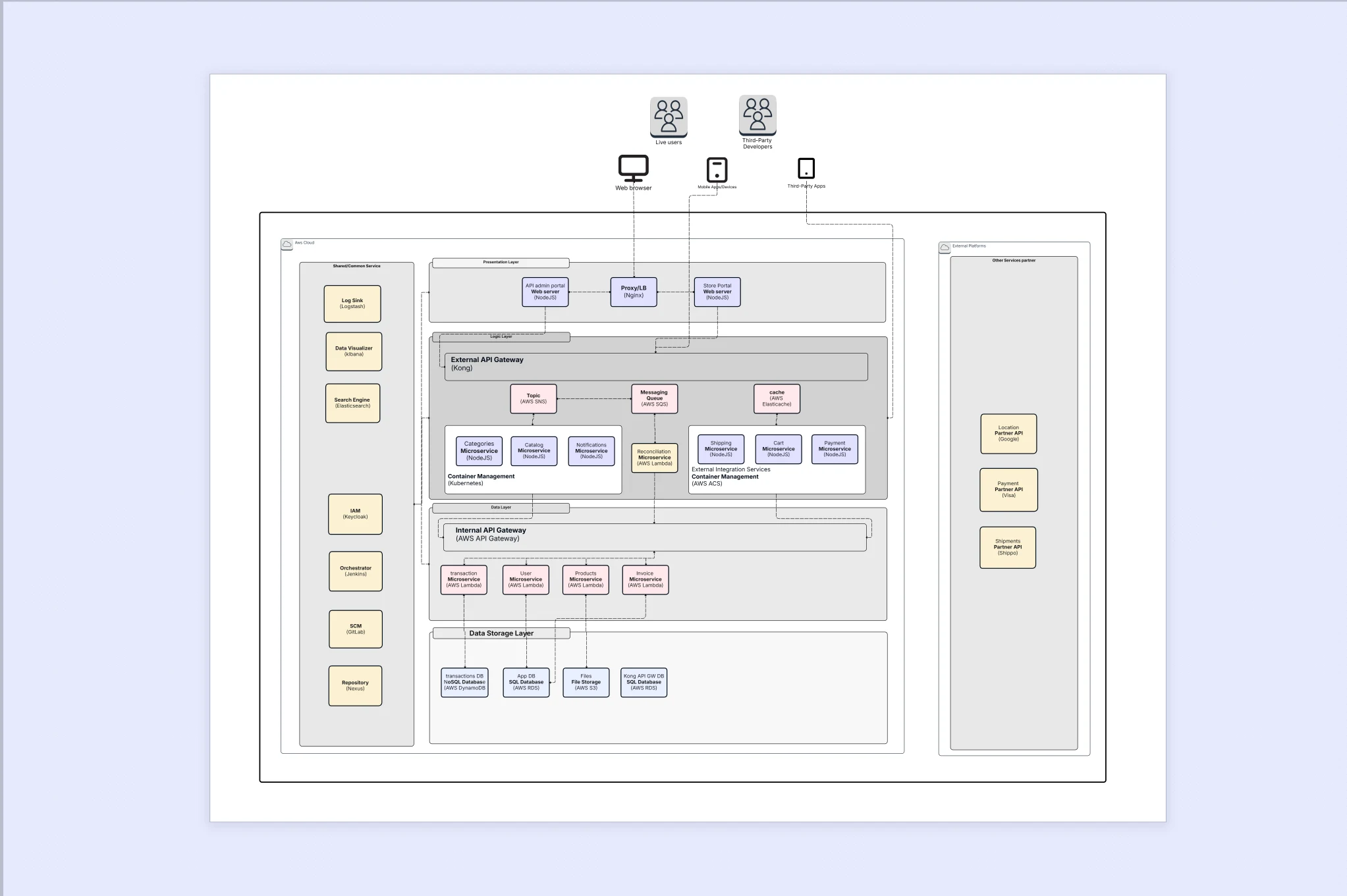
The technical architecture diagram template gives engineers an implementation-level map of infrastructure, applications, data, and security. Unlike high-level system architecture diagrams, this view details subnets, gateways, CI/CD, secrets, and observability. With a precise technical system architecture diagram, teams onboard faster, audit successfully, and resolve incidents quickly because dependencies and constraints are explicit, versioned, and linked to operational runbooks and controls.

what’s included in a technical architecture diagram template

This section defines the layers every technical architecture diagram should include to remain actionable in delivery and operations. By modeling infrastructure, applications, data, and security consistently, the technical system architecture diagram becomes a reliable artifact for review boards, SREs, and auditors, reducing ambiguity during change windows and post-incident analysis.

Plan and visualize system design clearly with Cloudairy’s system design templates

Infrastructure layer

Infrastructure is the foundation of the technical architecture diagram. Accurately showing regions, AZs, subnets, and routing reveals failure domains and capacity. A clear infrastructure H3 keeps the technical system architecture diagram credible for capacity planning and DR testing.

  • Cloud platforms - Specify regions, VPC/VNet design, NAT, and egress controls. The technical architecture diagram should show quotas and autoscaling policies to predict saturation.
  • On-premise systems - Depict clusters, storage arrays, and network segments. In a technical system architecture diagram, mark change windows and maintenance zones.
  • Connectivity - Include load balancers, gateways, and peering. Call out latency-sensitive paths so the technical architecture diagram supports performance tuning.

Application layer

Applications implement business logic and integrations. Rendering services clearly in the technical architecture diagram helps developers and SREs reason about deploys, rollbacks, and canary strategies. This H3 keeps the technical system architecture diagram aligned with the way software is shipped.

  • Microservices - Show service meshes, sidecars, and health checks. The technical architecture diagram should include API versions and limits to avoid breaking changes.
  • Legacy applications - Mark monoliths with runtime and dependencies so the technical system architecture diagram anticipates migration risk.
  • Deployment processes - Draw CI/CD stages, artifact repos, and approvals to make the technical architecture diagram a living release map.

Data layer

Data diagrams in a technical architecture diagram clarify durability, consistency, and lineage. This H3 ensures the technical system architecture diagram supports recovery objectives and privacy.

  • Databases - Note engines, clusters, replicas, and backup cadence so the technical architecture diagram anchors RPO/RTO.
  • Data lakes - Indicate zones (raw/curated), ingestion jobs, and schema enforcement within the technical system architecture diagram.
  • APIs - Show data contracts, throttles, and caching to keep the technical architecture diagram predictable under load.

Security layer

Security must be woven through the technical architecture diagram, not bolted on. Modeling authentication, authorization, and encryption here makes the technical system architecture diagram audit-ready and resilient.

  • Authentication - Place IdP, token flows, and session lifetimes so the technical architecture diagram prevents drift.
  • Authorization - Depict roles, ABAC/RBAC, and policy stores within the technical system architecture diagram.
  • Encryption - Show KMS/HSM, TLS policies, and key rotation to harden the technical architecture diagram.

When to use a technical architecture diagram template

The technical system architecture diagram is indispensable for detailed planning, audit readiness, and incident response. Because the technical architecture diagram captures exact dependencies and controls, it reduces ambiguity in change reviews and helps teams test failure scenarios before production events, shortening MTTR when issues occur.

  • For engineering teams - Provide a shared, implementation-accurate reference of services, infra, and data so dev, ops, and security collaborate effectively using the technical architecture diagram.
  • For audits - Demonstrate control coverage and evidence locations in the technical system architecture diagram, reducing back-and-forth with assessors.
  • For modernization - Map legacy to target states so the technical architecture diagram sequences migrations realistically.
  • For incident response - Trace dependencies and blast radius in the technical system architecture diagram, accelerating diagnosis and recovery.

How to customize a technical architecture diagram template

Adapt this technical architecture diagram template to your stack by adding provider-specific icons, change windows, and cost tags. Keep a legend and versioning so the technical system architecture diagram remains readable and trustworthy over time.

  • Add cloud providers - Use concrete AWS/Azure/GCP services with quotas so the technical architecture diagram supports capacity planning.
  • Show integrations - Draw APIs, queues, and service mesh routes, making the technical system architecture diagram testable.
  • Represent legacy systems - Flag monolith constraints to de-risk the technical architecture diagram during migration.
  • Include security measures - Place firewalls, secrets, and scanners so the technical system architecture diagram is audit-ready.

Example use cases of a technical architecture diagram template

A technical architecture diagram is practical wherever precision matters. These examples show how the technical system architecture diagram supports demanding environments.

  • Telecom - Document multi-site, low-latency systems and traffic flows within the technical architecture diagram.
  • Finance - Capture control mapping and data lineage in the technical system architecture diagram to satisfy regulators.
  • E-commerce - Model peak-season scaling and caching in the technical architecture diagram.
  • Healthcare - Show PHI zones and encryption paths in the technical system architecture diagram.

Summary

A precise technical architecture diagram turns complex systems into executable, auditable, and supportable designs. With consistent layers and annotations, the technical system architecture diagram accelerates delivery and reduces operational risk.

Explore More

Similar templates