50,000 + Trusted Users with
star star star star star

Trusted by Professionals at Leading Companies

What is a deployment diagram — example showing microservices nodes, containers, and artifact deployment

What Is a Component Diagram?

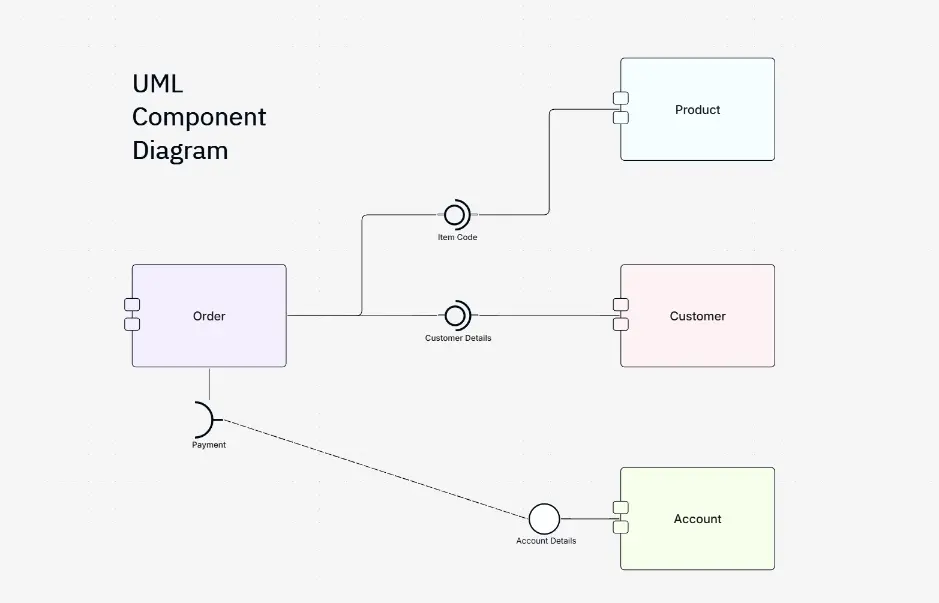
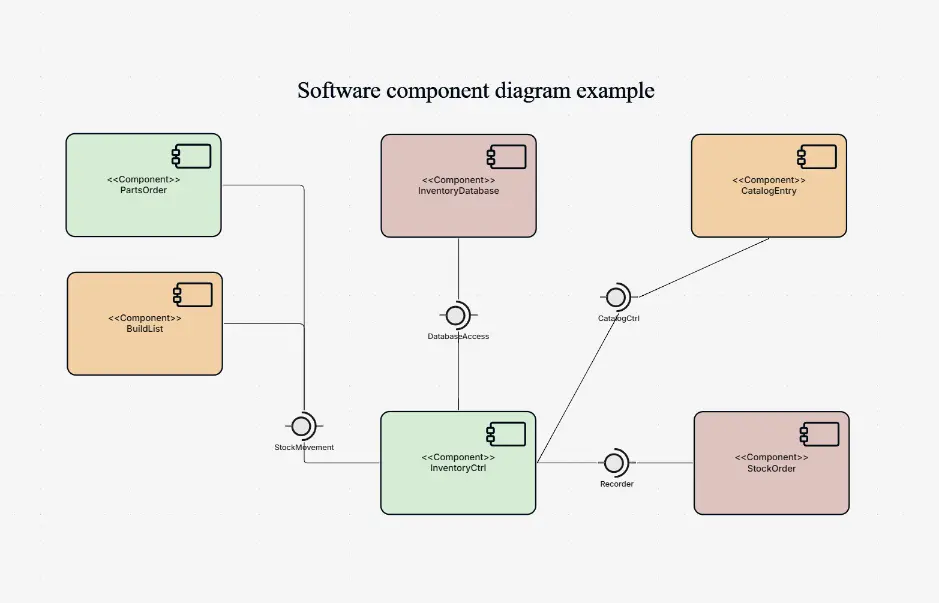
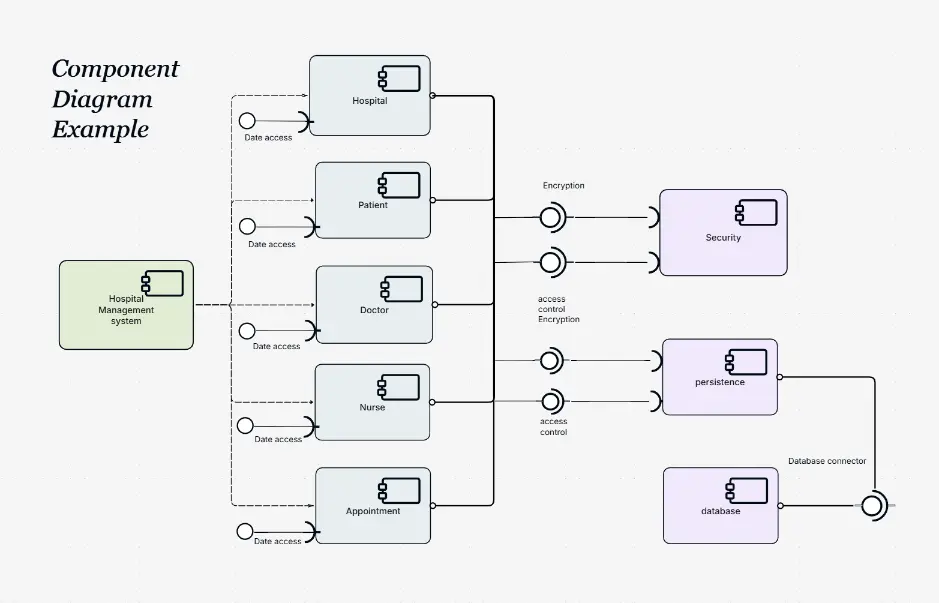
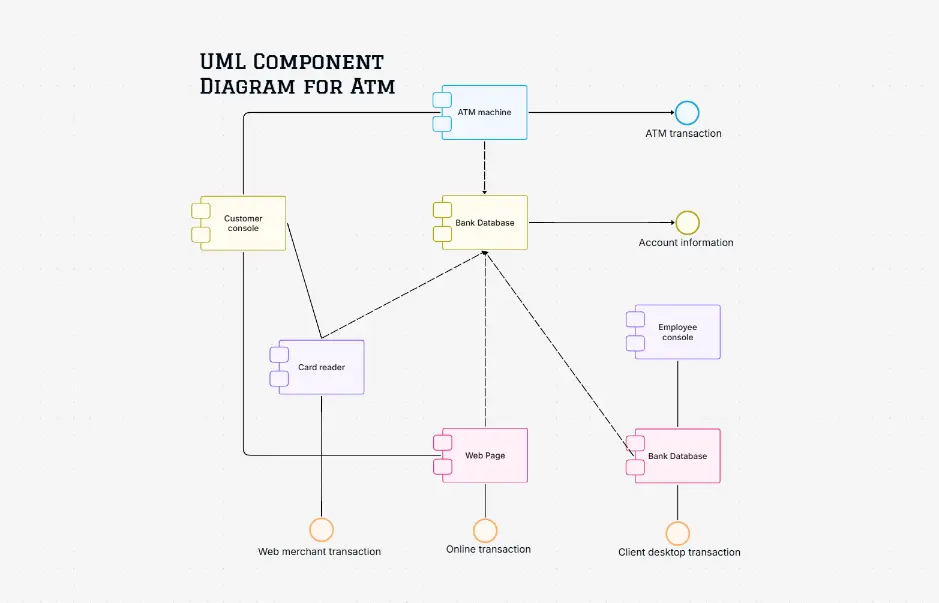
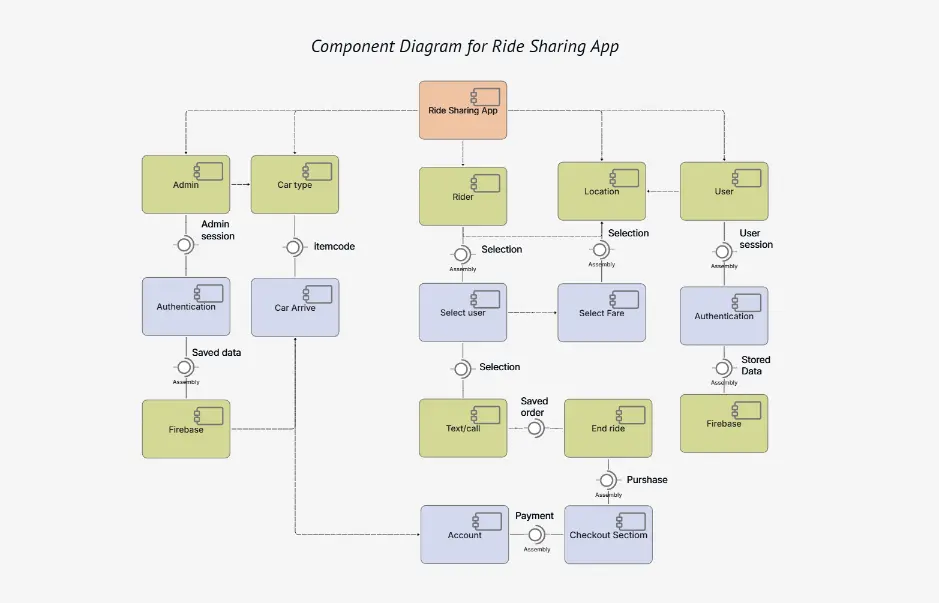
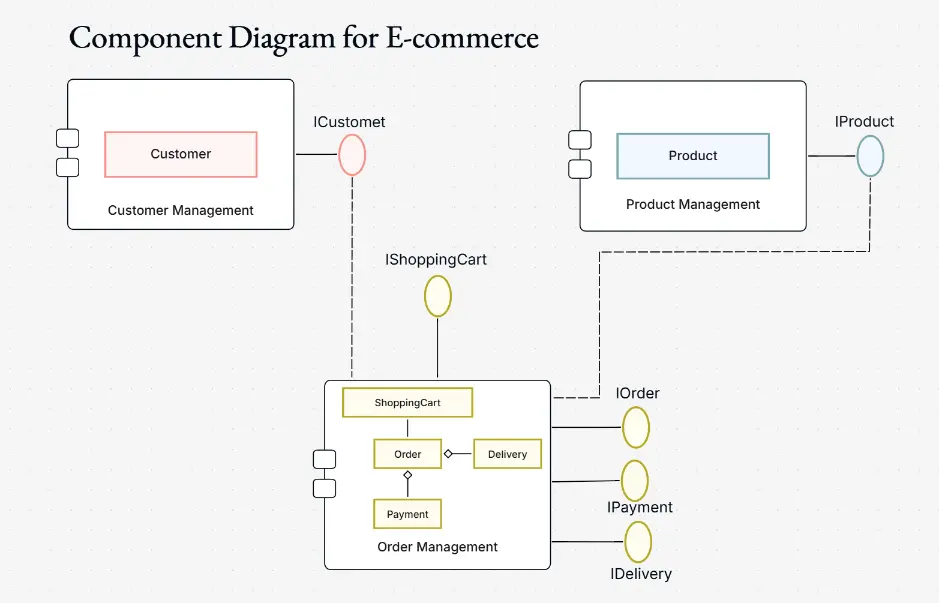
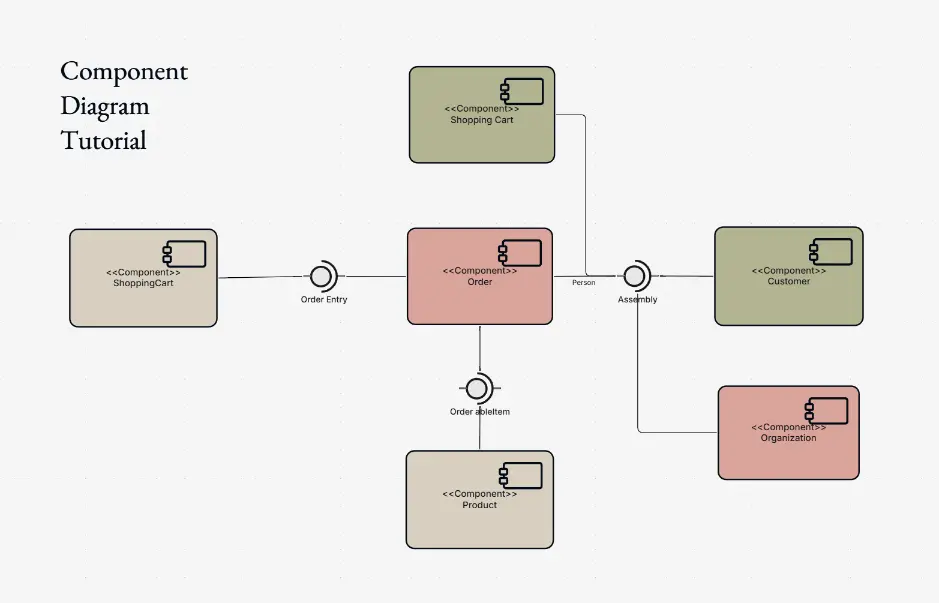
A component diagram is a type of structure diagram in the Unified Modeling Language (UML 2.5) that depicts the logical software architecture of a system. It shows how software components, interfaces, ports, and dependencies are organized — mapping the relationships between system parts so that your team, architects, and developers can understand the component structure, interfaces, and service topology.

Component diagrams are essential for enterprise architecture, microservices design, and C4 modeling. They serve as the source of truth for system design reviews, architectural documentation, API contracts, and service dependency mapping. Well-designed component diagrams use standard UML notation with proper components, interfaces, ports, provided/required relationships, and subsystem symbols.

Cloudairy's AI Component Diagram Maker goes beyond static templates. Describe your software architecture in plain English — "E-commerce platform with UI, order service, payment service, and inventory database" — and the AI produces a ready-to-edit UML 2.5 diagram instantly. Export to Visio, draw.io, PlantUML, or Mermaid format. Pair your component diagrams with deployment diagrams for complete system documentation, or use the sequence diagram maker for behavioral views.

How to Create a Component Diagram with AI

Describe your system's components and Cloudairy's AI generates a professional UML 2.5 component diagram in four steps — no manual drawing, no Visio license, no coding required.

1

Describe your system's components and relationships

Type a plain-English description in the AI prompt box. For example: "E-commerce platform with UI component, order service, payment service, inventory service, and database." Or choose one of the example prompt chips — Microservices, REST API, Event-driven system, Three-tier web app, Cloud deployment.

2

AI generates your component diagram

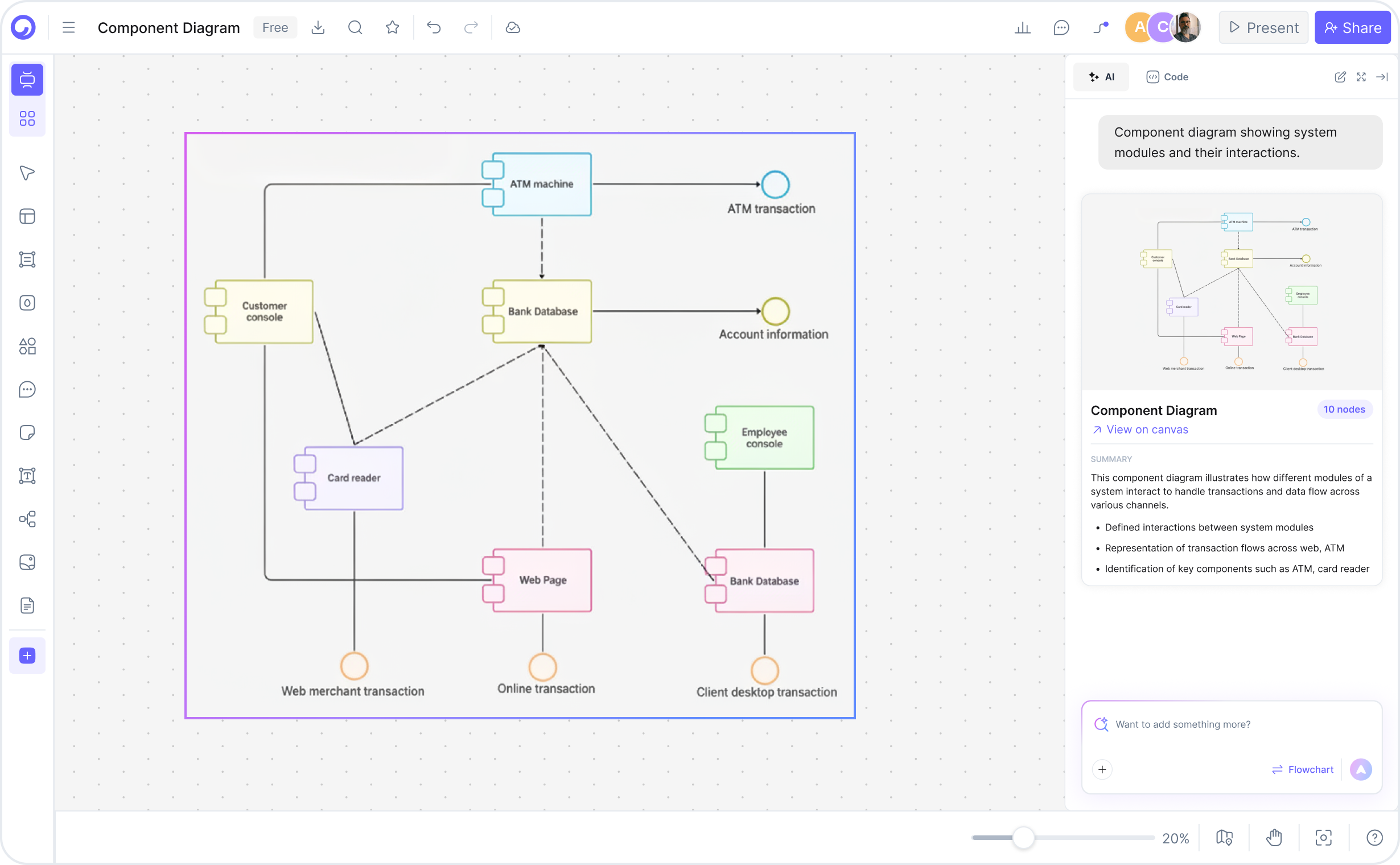
Cloudairy's AI instantly builds the UML 2.5 component diagram with proper notation. Components, interfaces (lollipops), ports, dependencies, and subsystems are correctly structured, and relationships show information flow automatically.

3

Edit and refine in the visual editor

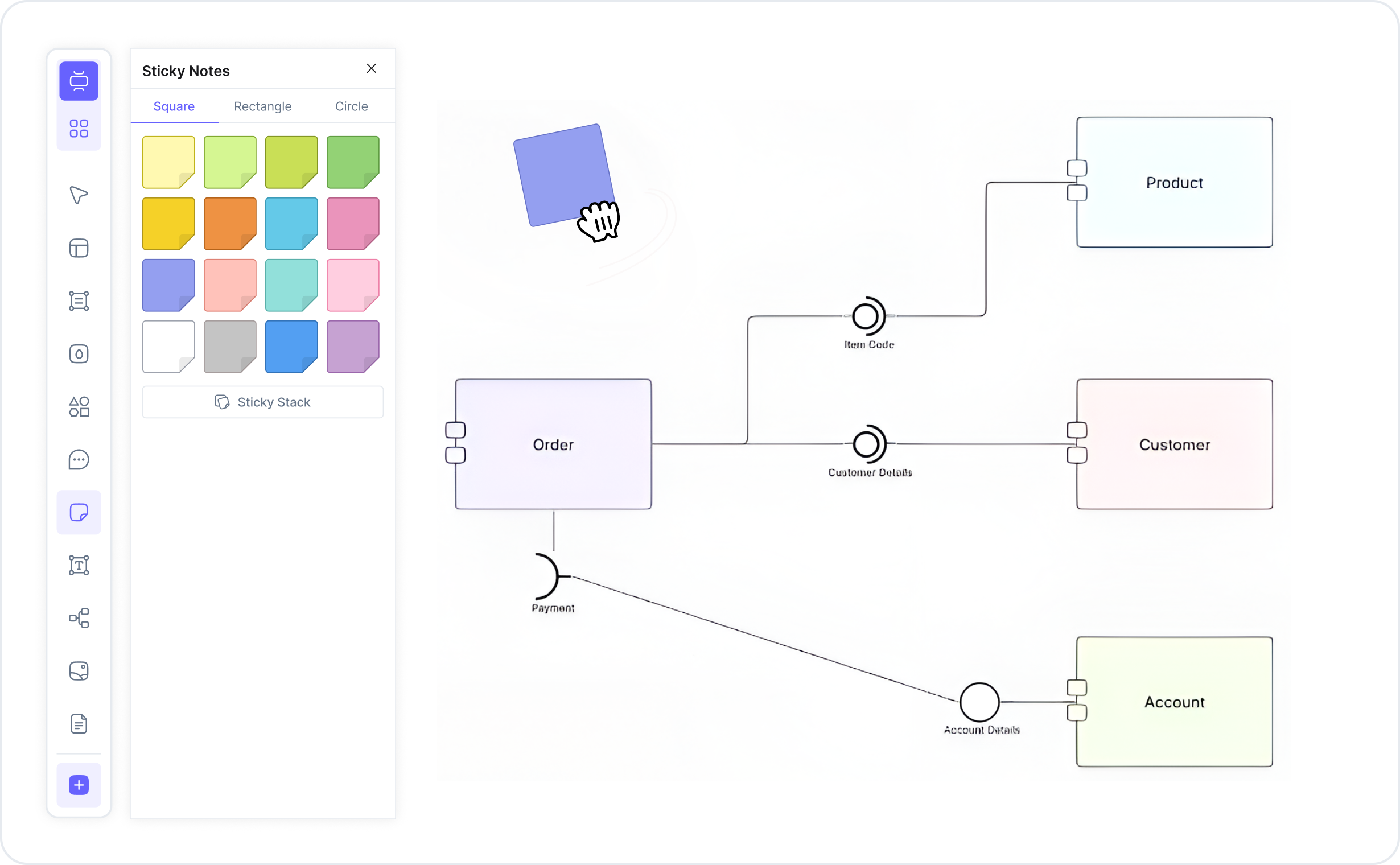
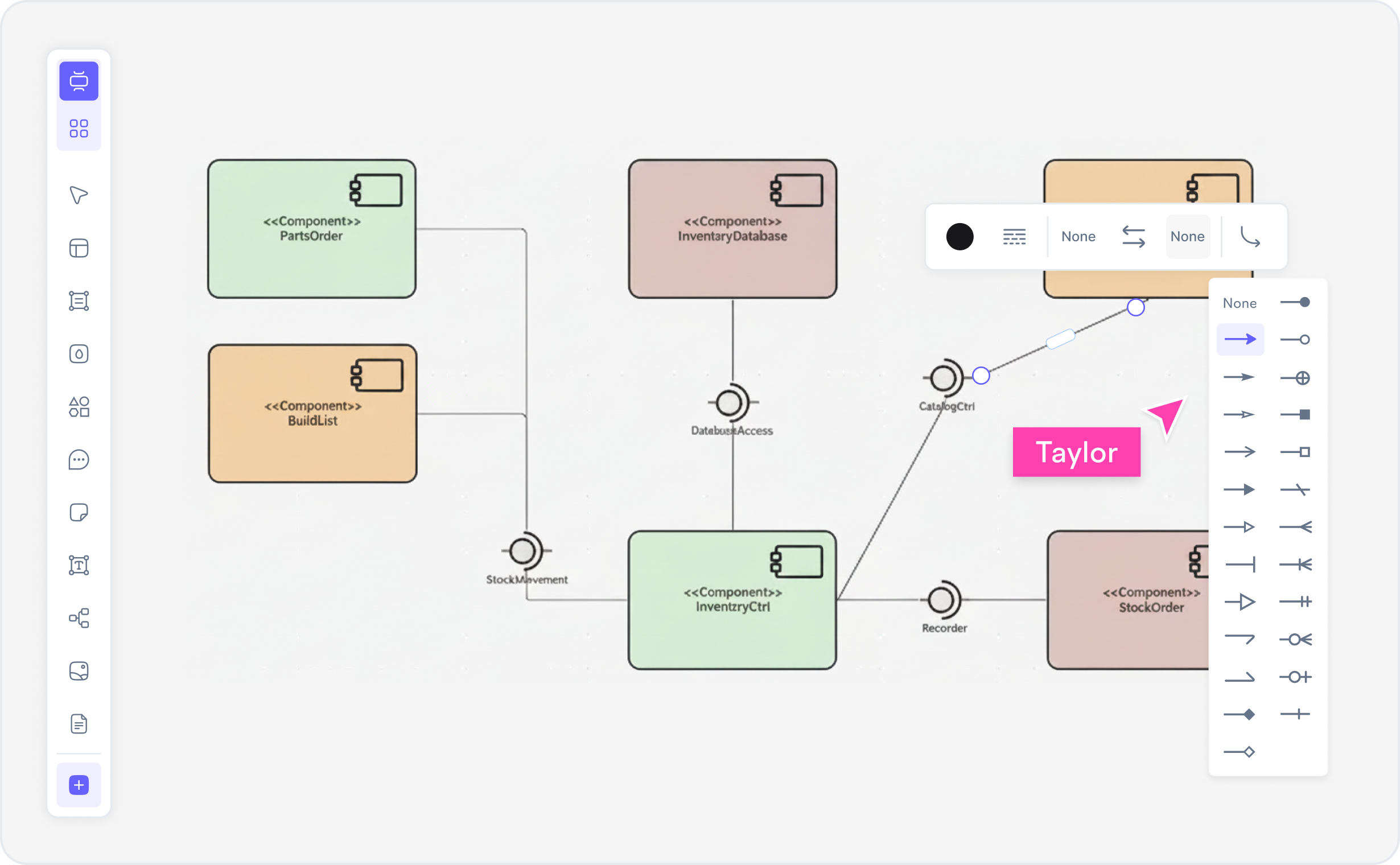
Refine the AI-generated diagram in Cloudairy's editor. Rearrange components, adjust interface types, add subsystems, insert stereotypes, or customize UML notation. Full support for C4 modeling, microservices patterns, and API architectures.

4

Export or share

Export to Visio (.vsdx), draw.io (.drawio), PlantUML, Mermaid, PNG, SVG, or PDF. Or copy a shareable live link for view-only or collaborative editing with your team — no account required for viewers.

How to create a component diagram with Cloudairy — four steps from prompt to export

Start Building Your Component Diagram Free

Join thousands of enterprise architects, microservices teams, and backend engineers who use Cloudairy to create UML 2.5 component diagrams in seconds. AI generation. UML notation. Real-time collaboration.

No credit card required • Start creating in seconds

Why Use Cloudairy as Your Component Diagram Tool

Cloudairy is the only tool that combines AI prompt-to-diagram generation with complete UML 2.5 component notation, C4 model support, multi-format export, and real-time collaboration — all on a single platform.

AI Prompt-to-Diagram

AI Prompt-to-Diagram

Describe your software architecture in natural language and get a complete, properly structured UML 2.5 component diagram in seconds. No templates to search, no shapes to drag from scratch. The AI understands microservices, C4 modeling, and architecture patterns.

UML 2.5 Notation

UML 2.5 Notation

Generate component diagrams with proper UML 2.5 structure diagram notation. Full support for components, interfaces (lollipops and sockets), ports, provided/required relationships, subsystems, and stereotypes. Compliant with Unified Modeling Language specification.

C4 Model Support

C4 Model & Architecture Patterns

Built-in templates for C4 Component diagrams, microservices architectures, RESTful APIs, event-driven systems, and enterprise patterns. Generate diagrams with proper UML component notation and map to C4 Container and Component levels automatically.

Multi-Format Export

Multi-Format Export

Export to Visio (.vsdx), draw.io (.drawio), PlantUML, C4 Model, PNG, SVG, or PDF. Choose the format that fits your workflow. No lock-in — your diagrams stay portable across tools and platforms.

Real-Time Collaboration

Real-Time Collaboration

Work on the same component diagram simultaneously with your team. Live cursor presence, inline comments, and @mentions keep architects and backend engineers aligned. Share view-only or edit links with no account required.

Version History and Sharing

Version History & Sharing

Track every change with full version history and branching. Roll back to any previous version, compare edits, and share specific diagram versions for deployment reviews. Shareable view-only links require no login.

Cloudairy vs. Other Component Diagram Tools

See how Cloudairy compares to the tools currently ranking for component diagram creation.

Capability Cloudairy Visio Lucidchart draw.io PlantUML C4 Model
AI prompt → diagram Yes No Limited No No No
UML 2.5 component notation Yes Yes Yes Yes Yes No
C4 model support Yes Partial No No No Yes
Interface/port modeling Yes Yes Yes Yes Yes Partial
Visio export (.vsdx) Yes Native No No No No
Mermaid syntax output Yes No No No No No
Real-time collaboration Yes Yes Yes No No Yes
Free tier available Yes No Limited Yes Yes Yes
Version history & branching Yes No Limited No No No

Who Uses Cloudairy for Component Diagrams?

Enterprise Architects

Design distributed systems and model software components. Generate UML component diagrams from plain English descriptions and align architecture with C4 model documentation for stakeholder communication.

Microservices Teams

Model service topology, document API contracts, and visualize component dependencies. Generate architecture diagrams from service descriptions and export to PlantUML or draw.io for team documentation.

Backend & Full-Stack Engineers

Document system architecture, component boundaries, and service interfaces. Create component diagrams directly from system requirements without manual drawing, then refine in the visual editor.

CS Students & Certification Candidates

Prepare for UML, software engineering, and systems design courses and certifications (TOGAF, ArchiMate). Generate component diagrams from architectural patterns to learn UML notation and design principles.

Systems Designers

Architect component-based systems with clear separation of concerns. Use the AI to generate initial component structure, then refine interfaces, ports, and dependencies collaboratively with your team.

Enterprise architects, microservices teams, and backend engineers using Cloudairy for component diagrams

Frequently Asked Questions

Cloudairy is the best free AI-powered component diagram maker. It combines an AI prompt-to-diagram experience with UML 2.5 notation, component relationships, and multi-format export (Visio, draw.io, PlantUML, C4 Model) — capabilities no other tool currently offers together on a single platform.

With Cloudairy: (1) Describe your software architecture and components in plain English in the AI prompt box. (2) Click Generate — Cloudairy's AI builds the UML 2.5 component diagram with interfaces, ports, and dependencies. (3) Customize using drag-and-drop. (4) Export to Visio, draw.io, PlantUML, C4 Model, PNG, SVG, or PDF.

Yes. Cloudairy offers a free tier that includes access to the AI component diagram maker with UML 2.5 notation support and PNG export. Premium plans unlock Visio export, unlimited boards, and team collaboration.

A component diagram is a type of UML 2.5 structure diagram that shows the physical architecture of a system by depicting software components, their interfaces, ports, and dependencies. Components represent reusable parts of the system that encapsulate functionality and communicate through well-defined interfaces.

Yes. Cloudairy supports two-way export to Visio (.vsdx) and draw.io (.drawio), plus PlantUML, C4 Model format, PNG, SVG, and PDF. This provides a frictionless migration path for teams using other diagramming tools.

A component diagram shows the high-level structure and dependencies of reusable components in a system, focusing on interfaces and relationships between components. A class diagram shows the detailed structure of individual classes, their attributes, methods, and associations. Component diagrams are useful for architecture planning; class diagrams are for detailed design.

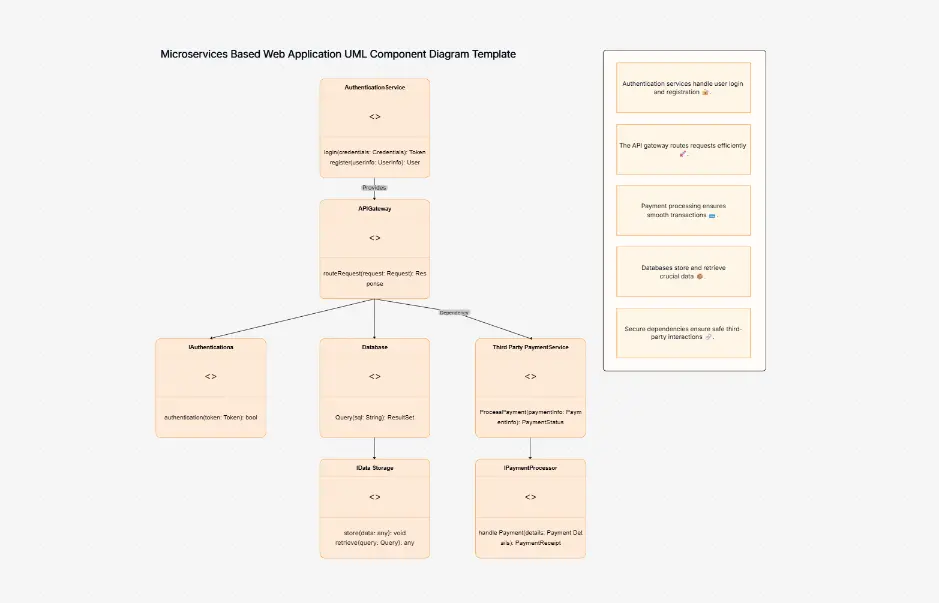
Yes. Component diagrams are ideal for modeling microservices architectures. Each microservice can be represented as a component with defined interfaces, and you can show dependencies, API contracts, and communication patterns between services using Cloudairy's AI-powered component diagram maker.

A well-designed component diagram includes components (representing reusable functionality), interfaces and ports (defining how components interact), dependencies (showing relationships between components), and subsystems (grouping related components). Cloudairy generates all these UML 2.5 elements from your plain English description.

Success Stories from Our Community

See how cloud architects, solutions engineers, and DevOps teams use Cloudairy to create Azure architecture diagrams faster and with better results.

As a cloud architect, I need precision and speed. Cloudairy helps me design complex Azure architectures in minutes without losing detail or accuracy. The official Azure icons save me hours every week.

Cloudairy makes Azure solution design so simple. I can create client-ready architecture diagrams instantly and focus on delivering value instead of spending hours formatting Visio files.

I'm studying for AZ-305 and Cloudairy helps me visualize Azure reference architectures instantly. I can generate a landing zone diagram from a single sentence and use it as a study aid.

I use Cloudairy to teach Azure architecture in my courses. The AI generator lets students produce real-world diagrams on the first day instead of spending weeks learning Visio.

Our team uses Cloudairy to document every Azure deployment. The Visio export means our diagrams drop straight into client deliverables without any reformatting. Huge time saver.

Secure, compliant, and enterprise-ready

Cloudairy safeguards your work with enterprise-grade security, compliance, and access controls — so your teams can create, collaborate, and scale with confidence.

SOC 2 Type II
SOC 2 Type Ⅱ

Cloudairy is SOC 2 Type Ⅱ certified and penetration tested annually, ensuring your architecture diagrams and data meet the highest standards for security and reliability.

GDPR
GDPR

We comply with the European Union General Data Protection Regulation (GDPR) and extend it to all our customers even those outside of the EU.

ISO 27001
ISO 27001

Our Information Security Management System is ISO 27001 certified — the leading global standard for information security.

Flexible Pricing for Every Team

Free

Discover what Cloudairy can do for you. Start for free

$0

for unlimited members
Try for free

Upgrade now

Show key features

up-arrow

Includes:

Starter

Unlock unlimited and private boards with important features

$4

per member / month

billed annually

monthly

Show key features

up-arrow

Includes everything in Free, plus:

money-back

Business

MOST POPULAR

Ideal for agencies or growing businesses managing multiple projects.

$5

per member / month
billed annually

Show key features

up-arrow

Includes everything in starter, plus:

Enterprise Plan

For large organizations needing scalability, control, and security.

contact-pricing
Contact for pricing
Contact us

Upgrade now

Show key features

up-arrow

Includes everything in Business, plus: