hero-bg-pricing

Get your team started in minutes

Sign up with your work email for seamless collaboration.

enterprise security models
Technical Diagramming

Enterprise Security Frameworks: SABSA vs TOGAF
Author
Cloudairy
By Cloudairy Team
December 29, 2025
10 min read

What Are SABSA and TOGAF?

SABSA and TOGAF are complementary enterprise frameworks. SABSA is a security-architecture method that starts with business requirements and turns them into measurable controls and services. TOGAF is a broad enterprise-architecture framework that organizes strategy, business, data, application, and technology architecture using its ADM lifecycle. Used together, SABSA supplies the security why and what, while TOGAF supplies the enterprise how and when across planning, governance, and delivery.
Why These Frameworks Matter Now

Hybrid and multi-cloud have blurred perimeters while regulations demand stronger evidence. Frameworks turn ad-hoc controls into an auditable system. SABSA aligns risk, business attributes, and security services, ensuring controls exist for clear reasons. TOGAF coordinates stakeholders, repositories, and governance so change is intentional and repeatable. Together, they give you business traceability for controls, architectural discipline for delivery, and the shared language executives and engineers need to stay aligned.

SABSA in Brief: A Business-Driven Security Architecture

SABSA starts with Business Attributes (e.g., integrity, privacy, availability) and traces them through layered models (Contextual → Conceptual → Logical → Physical → Component → Operational). Each layer answers specific questions—from why security exists to how it’s operated. You derive Security Services, patterns, and KPIs/KRIs that prove value. The payoff: risk-based design, measurable outcomes, and a catalogue of reusable patterns that map directly to business priorities.

TOGAF in Brief: An Enterprise Architecture Operating Model

TOGAF centers on the Architecture Development Method (ADM)—a phased cycle from vision and requirements through architecture definition, governance, and change management. It provides content metamodels, capability frameworks, and an Architecture Repository to keep artifacts consistent. Security is woven through all domains, with governance boards ensuring traceability and approvals. The payoff: a durable operating model for decisions, standards, and reuse across business, data, application, and technology.

SABSA vs TOGAF — Key Differences and Fit

Intro : Although both guide large programs, they focus on different problems. SABSA is security-specific and risk-first; TOGAF is enterprise-wide and process-first. The best choice depends on whether you’re clarifying why and what security must achieve or orchestrating how architecture is delivered and governed across the enterprise. Use this numbered comparison to place each framework where it’s strongest—and to spot integration points.

  1. Primary Purpose
    SABSA translates business risk into concrete security services and patterns with measurable attributes. It’s ideal for defining control intent and proving value.
    TOGAF coordinates enterprise change through ADM phases, repositories, and standards. It ensures architecture decisions are governed, catalogued, and reusable beyond security.
    Fit: use SABSA for security outcomes; use TOGAF to embed those outcomes into enterprise-wide change.
  2. Scope & Audience
    SABSA speaks to CISOs, security architects, and risk owners aligning attributes to controls. It stays tightly coupled to assurance and metrics.
    TOGAF targets CIOs, chief architects, and portfolio leaders managing business, data, app, and tech coherence.
    Fit: SABSA for depth in security; TOGAF for breadth across architecture domains and stakeholders.
  3. Artifacts & Traceability
    SABSA yields attribute ledgers, service catalogues, control patterns, and KRIs/KPIs proving effectiveness. Traceability runs from business attribute to runbook.
    TOGAF yields roadmaps, capability maps, standards, building blocks, and governance records across ADM.
    Fit: combine to trace from board-level objectives → SABSA attributes → TOGAF roadmaps and standards.
  4. Delivery Rhythm
    SABSA is iterative around risk changes, new attributes, and assurance outcomes.
    TOGAF follows ADM cycles (Vision → A–D → E–H) with checkpoints and governance gates.
    Fit: run SABSA discovery within TOGAF phases so risk insights shape each ADM iteration.
  5. Operationalization
    SABSA defines “what the control must achieve” and how to measure it in production.TOGAF ensures teams implement, govern, and maintain those controls at scale.Fit: SABSA sets intent; TOGAF institutionalizes it enterprise-wide.

How to Combine SABSA with TOGAF ADM

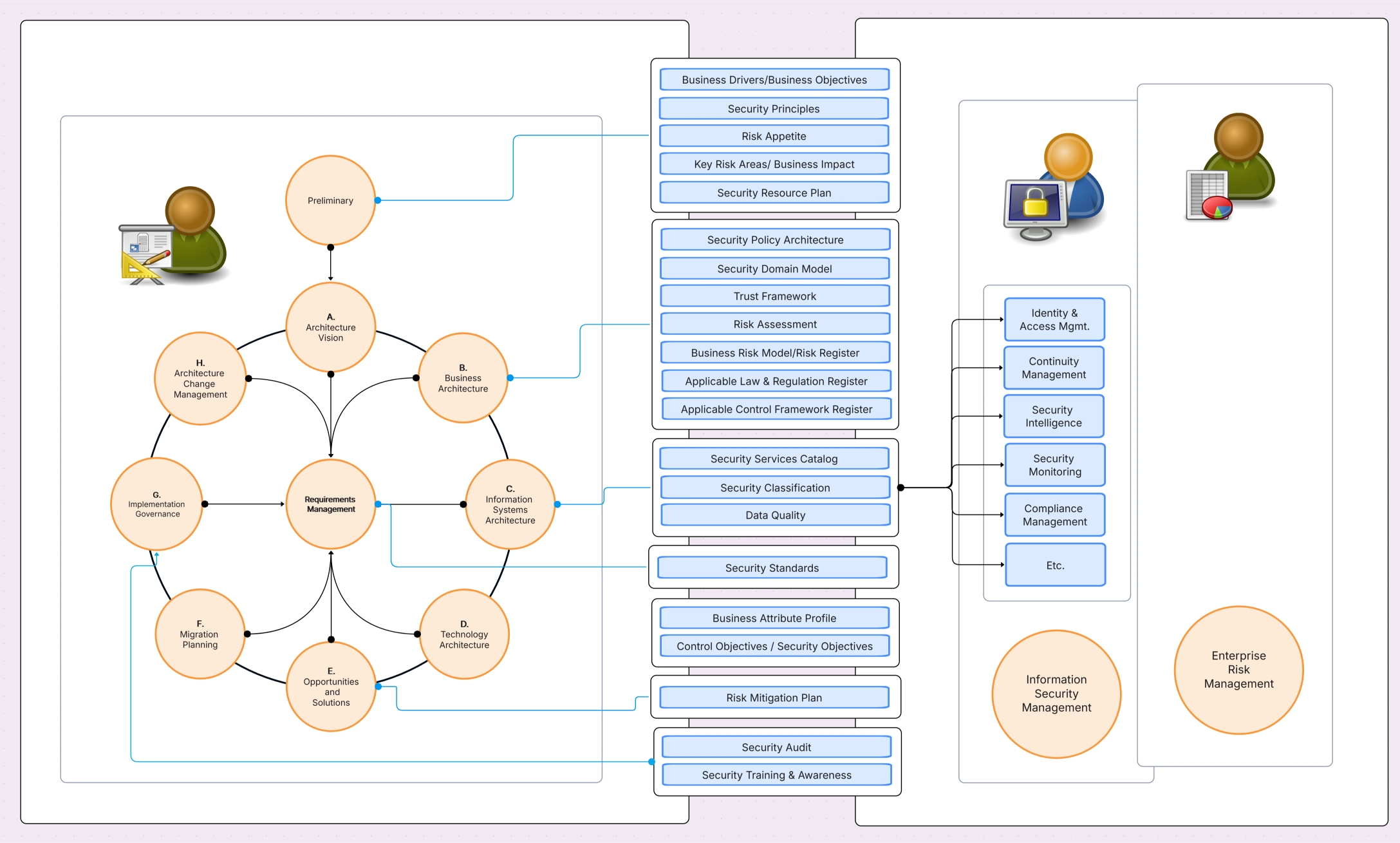
Intro : Many enterprises don’t choose one—they integrate both. Place SABSA’s business-attribute discovery and control definition inside TOGAF’s ADM checkpoints. That keeps security risk front-and-center while leveraging TOGAF’s governance, repository, and stakeholder machinery. The sequence below shows where SABSA activities enrich each ADM phase, producing artifacts your boards can approve and your teams can implement without losing risk traceability.

  1. Prelim & Vision (ADM: Preliminary, Phase A)
    Capture business drivers and compliance mandates. Run SABSA Contextual/Conceptual analysis to define attributes and security services. Record attribute-to-objective links in the Architecture Vision and Principles. Publish initial measurement hypotheses (KPIs/KRIs) for boards to endorse.
  2. Architecture Definition (ADM: Phases B–D)
    For Business, Application, Data, and Technology domains, map SABSA Logical/Physical controls to domain target states. Define patterns (e.g., Zero Trust access, data tokenization) and their evidence sources. Add dependencies, standards, and decision logs to the Architecture Repository.
  3. Planning & Governance (ADM: Phase E–F)
    Convert SABSA services into TOGAF work packages and transition architectures. Align funding, owners, and timelines. Establish governance criteria using SABSA measures so approvals are tied to observable outcomes, not checklists.
  4. Implementation & Operation (ADM: Phase G–H)
    Enforce design conformance during build; operationalize SABSA Component/Operational layers. Connect measures to Security Monitoring Architecture so dashboards prove control effectiveness. Feed lessons into the Architecture Change Management cycle.

Implementation Roadmap

Intro : Start small, prove value, then scale. Use a narrow slice—one critical journey, dataset, or platform—to exercise both frameworks together. Publish artifacts everyone can reuse, then expand by domain. The steps below create momentum without boiling the ocean and keep executive attention on measurable outcomes, not paperwork.

  1. Pick a Protection Surface & Outcomes
    Choose a revenue-critical app or regulated dataset. Define SABSA attributes (privacy, integrity, availability) and target KPIs/KRIs. Document success criteria: reduced standing privilege, faster revocation, fewer data egress paths.
  2. Author Patterns & Standards
    Produce 2–3 reference patterns (e.g., Zero Trust app access, IAM JIT admin, data tokenization). Convert to TOGAF standards and building blocks. Store in the repository with versioning and owners.
  3. Plan Transitions & Fund Work
    Roadmap releases with TOGAF work packages. Assign service owners, evidence sources, and test points. Tie funding to milestone measures so value stays visible.
  4. Build, Prove, and Operate
    Implement controls; validate with automated tests and monitoring. Run tabletop exercises and measure KPIs/KRIs. Hand off runbooks; register services in the catalogue.
  5. Scale & Institutionalize
    Socialize wins, then replicate patterns to new domains. Update standards, boards, and metrics thresholds. Embed reviews in quarterly governance so improvements persist.

Common Pitfalls and How to Avoid Them

Intro : Most failures come from paperwork without outcomes, or controls without governance. Avoid treating frameworks as templates to fill. Use them to create traceable value: specific risks reduced, privileges removed, incidents contained faster. The pitfalls below pair a symptom with a concrete corrective action you can take this quarter.

  1. Framework Theatre
    Beautiful artifacts, weak outcomes. Fix by binding approvals to SABSA KPIs/KRIs and refusing sign-off without evidence. Publish dashboards and retire controls that don’t move the needle.
  2. Security in a Silo
    SABSA outputs don’t reach delivery teams. Embed security architects in TOGAF domain workstreams; require patterns as dependencies for epics. Track reuse, not just publication.
  3. Over-engineering Early
    Year-long target states stall. Deliver a thin slice in 90 days. Lock one pattern, prove metrics, and scale. Treat everything else as backlog, not scope.
  4. Missing Repository Discipline
    Patterns live in slides. Use TOGAF’s repository and metamodel; version artifacts; assign owners. Archive superseded patterns so teams don’t pick stale guidance.
  5. No Operational Evidence
    Controls “exist” but aren’t measured. Wire patterns to Security Monitoring Architecture. Collect logs, tests, and reviews per service. Audit becomes export, not archaeology.

Which Should You Choose?

If you need to clarify what security must achieve and how to measure it, start with SABSA. If you must coordinate how architecture changes land and last across many domains, adopt TOGAF. Most enterprises benefit from both: SABSA for risk-anchored intent, TOGAF for enterprise delivery and governance. Use our Enterprise Security Architecture Template to align outputs from each and keep stakeholders working from the same map

Conclusion

SABSA and TOGAF aren’t rivals—they’re a powerful pairing. Let SABSA anchor security to business attributes and measurable outcomes, while TOGAF operationalizes those outcomes through an enterprise-grade lifecycle. Start with one protection surface, publish a reusable pattern, and prove value with live metrics. Build and iterate in the Security Architecture Diagram Tool using the Enterprise Security Architecture Template, then extend to Zero Trust and IAM for full coverage.
FAQs

1.Is SABSA only for security teams while TOGAF is for architects?

SABSA is security-centric, but its business-attribute language suits executives and risk owners. TOGAF targets enterprise architects, yet security is a cross-cutting concern. Together they create shared understanding.

2.Can SABSA replace TOGAF?

No. SABSA defines security intent and evidence; TOGAF governs enterprise delivery. Use SABSA within TOGAF’s ADM to keep risk and governance aligned.

3.How do I show value to leadership?

Publish SABSA KPIs/KRIs tied to business attributes, then track them on TOGAF governance dashboards. Report privilege reduction, faster revocation, and incident containment times.

4.Where do Zero Trust and IAM fit?

They’re patterns and services inside SABSA, delivered and governed through TOGAF. See Zero Trust Blog and IAM Best Practices.

5.What artifact should I build first?

Start with a SABSA Business Attribute Profile for one protection surface, then a TOGAF work package that delivers a reference pattern with measurable evidence.

Ready to create smarter with AI?

Start using Cloudairy to design diagrams, documents, and workflows instantly. Harness AI to brainstorm, plan, and build—all in one platform.

Recommended for you
C4 Diagrams for Software Engineering
Technical Diagramming