Security in Microservices Architecture Template

Cloudairy
 Copy link

Get your team started in minutes
Sign up with your work email for seamless collaboration.
Whiteboard
Copy link

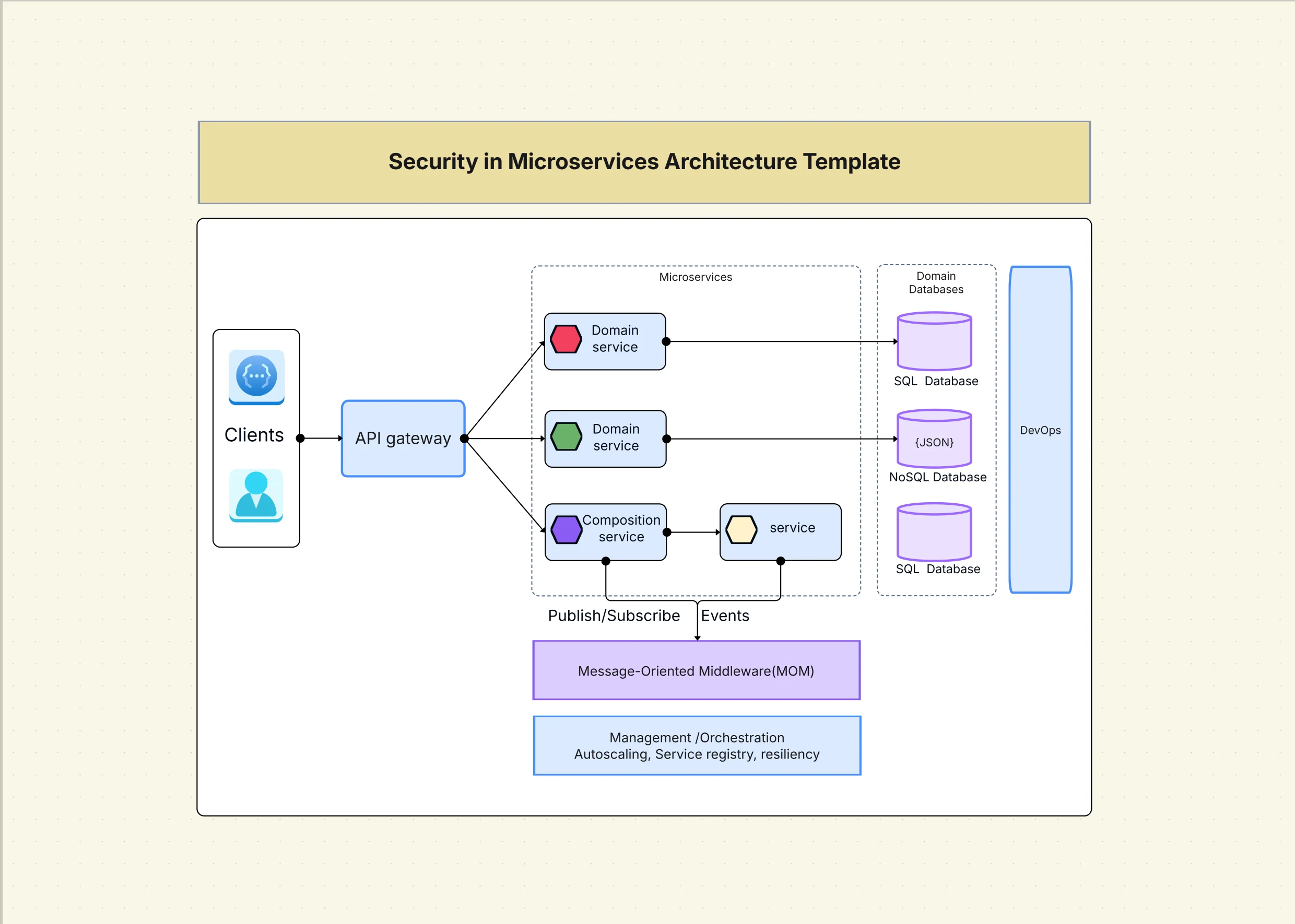
Secure APIs, services, and data flows using this Microservices Security Architecture Template. Visualize identity management, monitoring, encryption, and zero-trust controls to design scalable, resilient, and secure microservices architectures.
Secure APIs, services, and data flows using this Microservices Security Architecture Template. Visualize identity management, monitoring, encryption, and zero-trust controls to design scalable, resilient, and secure microservices architectures.
Security in a microservices architecture is about safeguarding a decentralized system where each service is an independent entity. In contrast to monoliths, microservices systems require distributed trust, identity verification, and secure API interactions. This template demonstrates the use of zero, trust principles, encrypted service, to, service communication, and context, aware authorization rules across clusters. So, it makes sure that every part is checkable, loggable, and sturdy. Putting these layers side by side helps the teams to handle the intricacies and keep the security up to the mark, which is also scalable, across the ever, changing containerized deployments.
A microservices security framework divides the security mechanisms into different modules resembling the ways modern applications are deployed and scaled. As each service uses APIs to communicate, therefore encryption, authentication, and authorization form the core. The template further provisions for orchestration tools such as Kubernetes, which need tight control for service discovery and traffic management. The common defense system you get by linking these elements, gateways, identity providers, and observability stacks, is not only adaptable, automated but also under constant supervision.
See below for what’s included in this microservices security architecture template:
Every layer in a microservices security architecture is designed to perform a specific function to guarantee the identity, integrity, and confidentiality of a decentralized service. Such a layered setup stops attackers from being able to take advantage of one weak link to carry out a system, wide breach. The core of it rests on three measures: verification, encryption, and visibility. These, in unison, form a security fabric that can change as containers are scaled, API calls are made, or multi, environment deployments are carried out, yet the service mesh remains consistent.
See below for the foundational security layers within this template:
As microservices need to interact with each other, it is really necessary that the security of their connections and a continuous supervision are enforced. The present chapter provides the description of the communication flows structuring with the authentication being done at each hop, the logging being centralized, and the gateways being policy, driven. Besides that, monitoring gives the possibility to see the API behavior as well as the dependency chains. All these means of control together convert the dispersed microservice environments into systems that are in line with the policy, traceable, and where each request is checked, logged, and managed from the source to the destination.
See below for the core communication and monitoring controls covered in this template:
The Microservices Security Architecture Template is crucial when adopting containerized applications, serverless functions, or cloud-native patterns. It visualizes relationships between APIs, identity systems, and network controls, helping teams identify weak points early. Whether migrating from monoliths or implementing zero-trust frameworks, this diagram streamlines communication between DevOps, security, and compliance teams - ensuring policies scale as dynamically as services themselves.
See below for when to use this microservices security template:
Every microservices deployment is unique - with varying frameworks, APIs, and cloud providers - so your security architecture must be flexible. Customizing this template helps you reflect real-world clusters, define clear trust boundaries, and integrate existing tools. Tailoring also ensures compliance readiness and improves team communication by making architecture maps understandable for technical and non-technical stakeholders alike.
See below for how to personalize your microservices security architecture:
A Microservices Security Architecture Template supports any organization operating distributed applications. It helps teams balance speed with governance - enabling safe innovation without loss of visibility. Whether you’re securing APIs in fintech or scaling IoT platforms, this structure ensures every interaction is traceable, authenticated, and compliant with industry frameworks.
See below for real-world microservices security use cases:
1. What is a Microservices Security Architecture Template used for?
It visualizes controls that secure microservice ecosystems - mapping authentication, encryption, monitoring, and access enforcement across clusters.
2. How does this relate to Zero Trust?
It implements Zero Trust by requiring continuous verification between every service and identity, regardless of network placement.
3. Can I use this in Kubernetes or Docker?
Yes. The template is designed for containerized environments, integrating native tools like Istio, OPA, and Kubernetes RBAC.
4. Is it suitable for multi-cloud architectures?
Absolutely. It accommodates multi-cloud deployments, showing consistent policies and observability across providers.
5. How do I start building it?
Use the Security Architecture Diagram Tool to select this template and begin customizing identity, traffic, and policy layers visually.
Loading subcategories...
 Manage all your work in one place
Collaborate with your team
Use Cloudairy for FREE—forever
Explore More