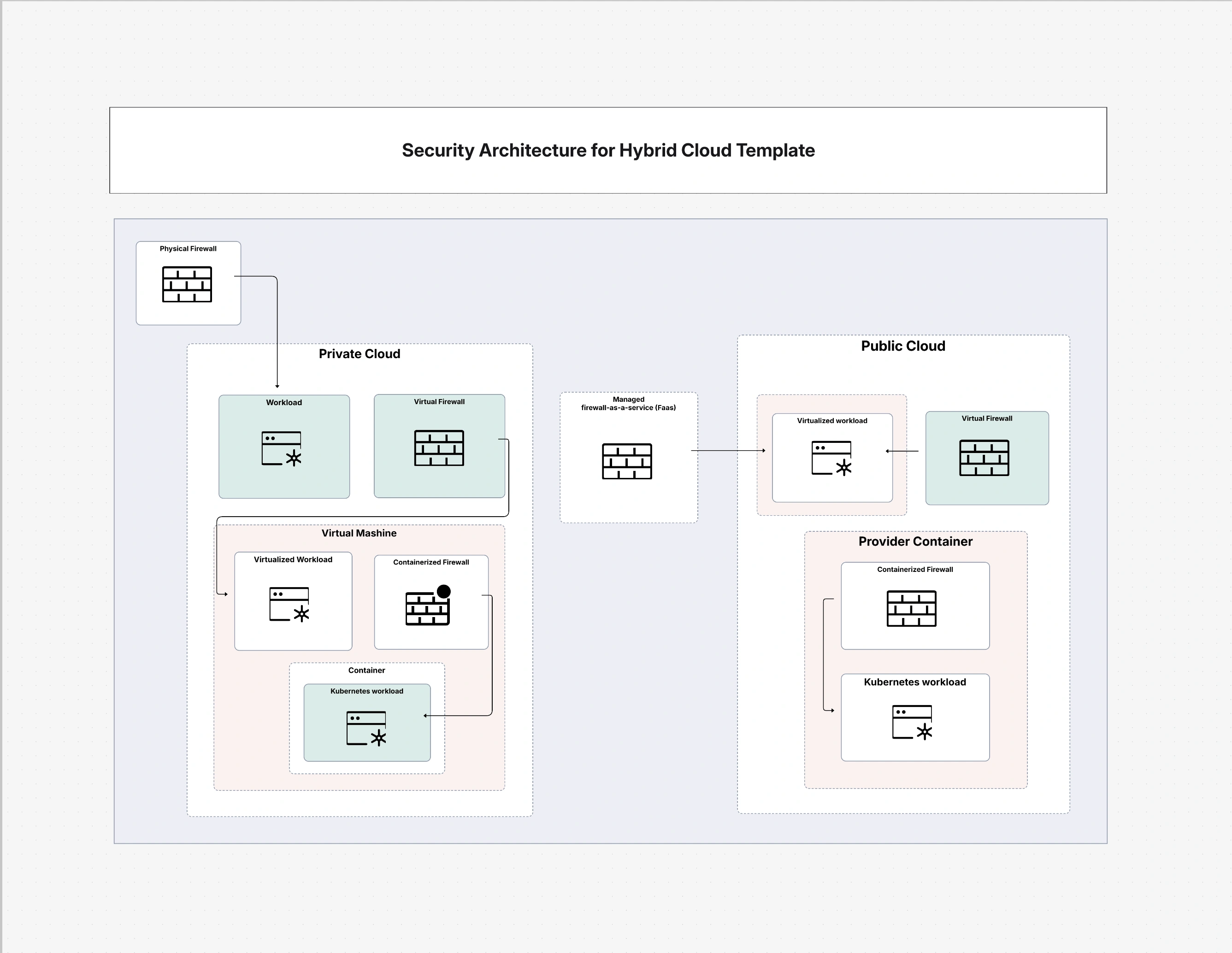
Hybrid Cloud Security Architecture Template

Cloudairy
 Copy link

Get your team started in minutes
Sign up with your work email for seamless collaboration.
Whiteboard
Copy link

Design secure hybrid cloud systems with this Security Architecture Template. Visualize IAM, encryption, compliance controls, and continuous monitoring across on-prem, cloud, and multi-cloud environments to build scalable, compliant, and resilient infrastructure.
Design secure hybrid cloud systems with this Security Architecture Template. Visualize IAM, encryption, compliance controls, and continuous monitoring across on-prem, cloud, and multi-cloud environments to build scalable, compliant, and resilient infrastructure.
A hybrid cloud security architecture Template illustrates in detail the methods of securing systems that are based both on the local data center and the cloud services from different providers. It charts the control layers, trust zones, and compliance boundaries to guarantee the same level of governance and visibility in all environments.With this template, teams are able to lay out the access policies, encryption strategies, and threat detection frameworks that are shared across the different environments. It is a tool for security architects to handle the intricacies of the hybrid model and at the same time be compliant with the regulations and have the freedom to operate.
An efficiently planned hybrid cloud security system interlinks identity management, data protection, and workload isolation, control being exercised through a single governance model. It provides a transition between policies in the private and public clouds, thus guaranteeing both the security of communication and the stability of the enforcement. Such a system enables companies to escape from illusory pits of insight, lessen the number of possible erroneous configurations and preserve their conformity to regulations despite the fact that their workloads may be moving in a rapid manner across different environments. As a result of having these aspects clearly defined on paper, different teams will be able to synchronize their DevOps, SecOps, and compliance processes which will all be governed by one uniform security strategy.
See below for what’s included in this hybrid cloud security architecture template:
A layered hybrid cloud security architecture guarantees that every layer, be it networking or identity, is protected under the same management. It shares the liability of security measures between different levels but keeps the execution of these measures at a uniform level across different environments. The current chapter is about the coordination of security measures at the infrastructure level with those at the application and user level. As a result of this integration, companies have a highly flexible defense system which is always at the same level with their security and compliance even when the workloads are relocated.
See below for the foundational hybrid security layers in this template:
In a hybrid ecosystem, the rules of governance and compliance are the essential factors that lead to security being maintained in the long run. The hybrid cloud security governance model presented here accomplishes the application of the policies in the same manner, i.e., they go through all the platforms wherever the resources span. There should be a single approach to monitoring, auditing, and evidence collection so that regulatory blind spots do not arise. The current section is devoted to the ways an enterprise may establish well, organized governance, which is facilitated by the ongoing visibility and the automated compliance checks being carried out in the hybrid environments.
See below for how governance and monitoring are applied within this template:
The Hybrid Cloud Security Architecture Template is a must, have tool to figure out or resize the hybrid infrastructure combining the on, premises systems with the public clouds. It visually explains the ways to implement consistent controls in different platforms. In case you are upgrading old systems or taking the multi, cloud route, this template assists companies in harmonizing their architecture decisions with their business and compliance objectives, thus still being able to keep their agility, performance, and security visibility. Visit now to strengthen protection with effective Security Detect Finding practices.
See below for when to use this hybrid cloud template:
By adjusting a hybrid cloud security framework, you can guarantee that it is in line with the individual allocation of workloads and the range of regulations of your organization. Each enterprise varies in terms of cloud maturity levels, providers, and dependencies. Customizing the chart assists in setting up clear trust boundaries and getting rid of the intricacies that are there just for show. When the model is adjusted, the teams have the possibility to not only achieve the best performance but also to keep the security measures consistent in different environments, whether they are separated geographically or technically.
See below for how to tailor this hybrid cloud architecture template:
A Hybrid Cloud Security Architecture Template is a universally applicable solution that maintains equilibrium between scalability and control across different industries. Essentially, it caters to the needs of those companies which have a highly sensitive workload that cannot be entirely shifted to the public cloud but still need the flexibility of the cloud, native approach. Bringing control and trust models into view, the teams can continue to have trust while working in mixed environments. In addition, this template helps top management communicational by converting the intricacies of hybrid into straightforward, quantifiable elements of the corporate security. Explore faster issue resolution with Incident Remediation Automation.
See below for hybrid cloud architecture use cases:
1. What is a Hybrid Cloud Security Architecture Template used for?
It’s a visual blueprint that shows how controls, policies, and monitoring unify across on-prem and cloud systems to maintain consistent governance and visibility.
2. Why is hybrid cloud security complex?
Because it blends different environments, tools, and ownership models — requiring centralized policies, encryption, and identity management to maintain uniform protection.
3. Can it integrate Zero Trust principles?
Yes. It aligns perfectly with Zero Trust by enforcing identity validation, segmentation, and continuous verification across clouds.
4. Is it suitable for multi-cloud setups?
Absolutely. It supports multiple providers, ensuring each follows shared governance, identity federation, and monitoring frameworks.
5. How do I start building this diagram?
Use the Security Architecture Diagram Tool to select this template, map your hybrid environments, and customize enforcement layers visually.
Loading subcategories...
 Manage all your work in one place
Collaborate with your team
Use Cloudairy for FREE—forever
Explore More