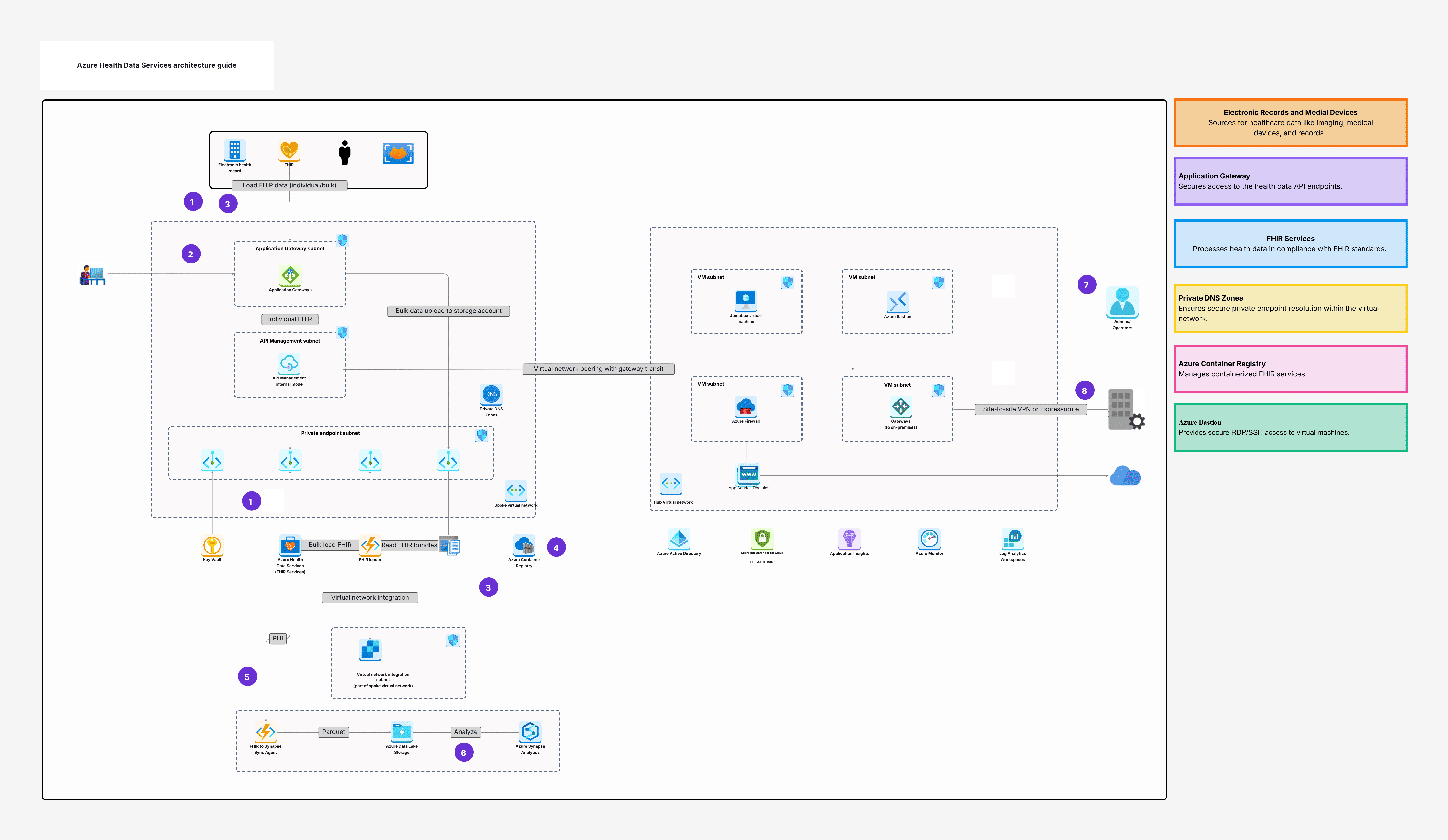
Azure Health Data Services Architecture Guide Template

Cloudairy
 Copy link

Get your team started in minutes
Sign up with your work email for seamless collaboration.
Whiteboard
Copy link

Explore Azure Health Data Services architecture to securely manage, store, and analyze healthcare data with compliance and interoperability at scale.
Explore Azure Health Data Services architecture to securely manage, store, and analyze healthcare data with compliance and interoperability at scale.
This template takes the complex work of designing healthcare data architecture and packages it into an easy-to-fThis thoughtfully designed template simplifies the complex process of building healthcare data architecture by offering a step by step, personalized framework. It contains all the important tools your healthcare team genuinely requires to manage patient information, diagnostic images, clinical data, and other private healthcare details responsibly. Instead of struggling to make various healthcare systems collaborate, you gain a proven, adaptable framework that aligns with established healthcare API and data-sharing standards.
The Azure Health Data Services architecture template is purposefully crafted to solve real challenges in healthcare technology. It emphasizes strong data privacy, FHIR based standardization, and seamless HL7 integration. This ensures your team maintains compliance, achieves interoperability, and delivers more purposeful, data driven patient outcomes.
Using this azure health data services architecture guide template saves your healthcare organization months of planning and significantly reduces the risk of compliance violations when building critical patient data systems. When healthcare providers try to create their data architecture without proper guidance, they often struggle with complex regulatory requirements and technical integration challenges that can delay patient care improvements and cost substantial resources.
The template provides a proven foundation that already incorporates healthcare compliance best practices and standardized healthcare APIs. This means your IT teams can focus on improving patient outcomes instead of spending time figuring out technical integration puzzles. You also get the benefit of FHIR-compliant data structures, which make it much easier to share patient information securely between different healthcare systems and providers.
Another major advantage is that the template helps you meet healthcare regulations like HIPAA more effectively. Healthcare compliance is incredibly complex, and this template includes architectural patterns that align with patient privacy requirements and medical data security standards. This reduces the risk of data breaches or compliance issues that could result in costly penalties and damage to patient trust.
The azure health data services architecture template also enables better interoperability through standardized HL7 messaging and FHIR protocols, allowing your systems to communicate more effectively with other healthcare providers, laboratories, and medical devices.
If you are part of a healthcare organization looking to streamline patient data management, the Azure Health Data Services architecture template might be exactly what you need. It is built for hospitals, clinics, and health tech companies that want to take advantage of Azure’s cloud while still keeping every compliance standard firmly in place.
IT architects and developers appreciate how straightforward it is. The built-in guidance for FHIR-based systems and healthcare APIs means you don’t have to be an expert in every health data standard to get things running smoothly. Many organizations also use it to connect different healthcare systems or build patient portals that pull data from multiple trusted sources.
Smaller healthcare providers gain the most since it gives them powerful, enterprise-level capabilities without needing deep technical expertise. It fits perfectly for those upgrading old systems or transitioning into fully interoperable digital ecosystems.
For startups and telemedicine businesses in particular, this template helps kickstart a compliant, standards-based architecture quickly, saving time while keeping development in line with all the necessary regulations.
1. FHIR and Interoperability Excellence
This template was thoughtfully designed to help healthcare organizations like yours streamline data management while keeping security at the forefront. By offering well-structured FHIR implementation guidance, it enables smooth data exchange and full interoperability across healthcare systems and providers.
2. Standardized Healthcare APIs and HL7 Integration
APIs built on this template follow HL7 and FHIR standards closely, resulting in consistent, reliable communication across your healthcare infrastructure. The approach minimizes data isolation and enhances collaboration among care teams.
3. Improved Patient Safety and Data Accessibility
With well-integrated APIs, healthcare professionals gain rapid access to precise, complete patient data. This reduces treatment errors, avoids redundant procedures, and strengthens clinical decision-making, contributing directly to safer patient care.
4. Operational and Cost Efficiency
The Azure architecture model improves efficiency by reusing standardized patterns to handle lab results, records, and imaging workflows. It saves significant development effort and reduces costs by cutting down on custom integration work, allowing teams to prioritize innovations in patient care.
5. Security and Compliance Strength
Security and compliance are strengthened through the template built-in protections that combine Azure's healthcare-grade security with industry standard approaches to protecting patient data and ensuring HIPAA compliance.
It is easy to get started with the Azure Health Data Services Architecture Guide template in Cloudairy:
The azure health data services architecture template comes with pre-built sections for FHIR server configurations, HL7 message routing, healthcare APIs design patterns, patient data security frameworks, and compliance checklists, making it easy to customize for your organization's specific health data requirements.
If your healthcare grouping is looking to modernize its data systems, the Azure Health Data Services Architecture Guide Template is a great place to start. It gives you a ready-made structure for building secure, compliant platforms that use FHIR and HL7 standards so your teams can focus more on care and less on technical setup. Azure’s cloud tools make it easier to connect different systems and improve how patient data flows between departments. Design secure healthcare solutions with a detailed Azure Architecture Diagram using this Azure Health Data Services Architecture template.
This template suits both healthcare providers and tech companies eager to push their digital conversion forward. By starting with Azure’s well tested architecture, you can meet regulatory demands, maintain patient privacy, and quickly build a foundation for smarter, more linked healthcare. Streamline your healthcare solution planning with a structured Architecture & Technical Design using this Azure Health Data Services Architecture template.
Loading subcategories...
 Manage all your work in one place
Collaborate with your team
Use Cloudairy for FREE—forever
Explore More