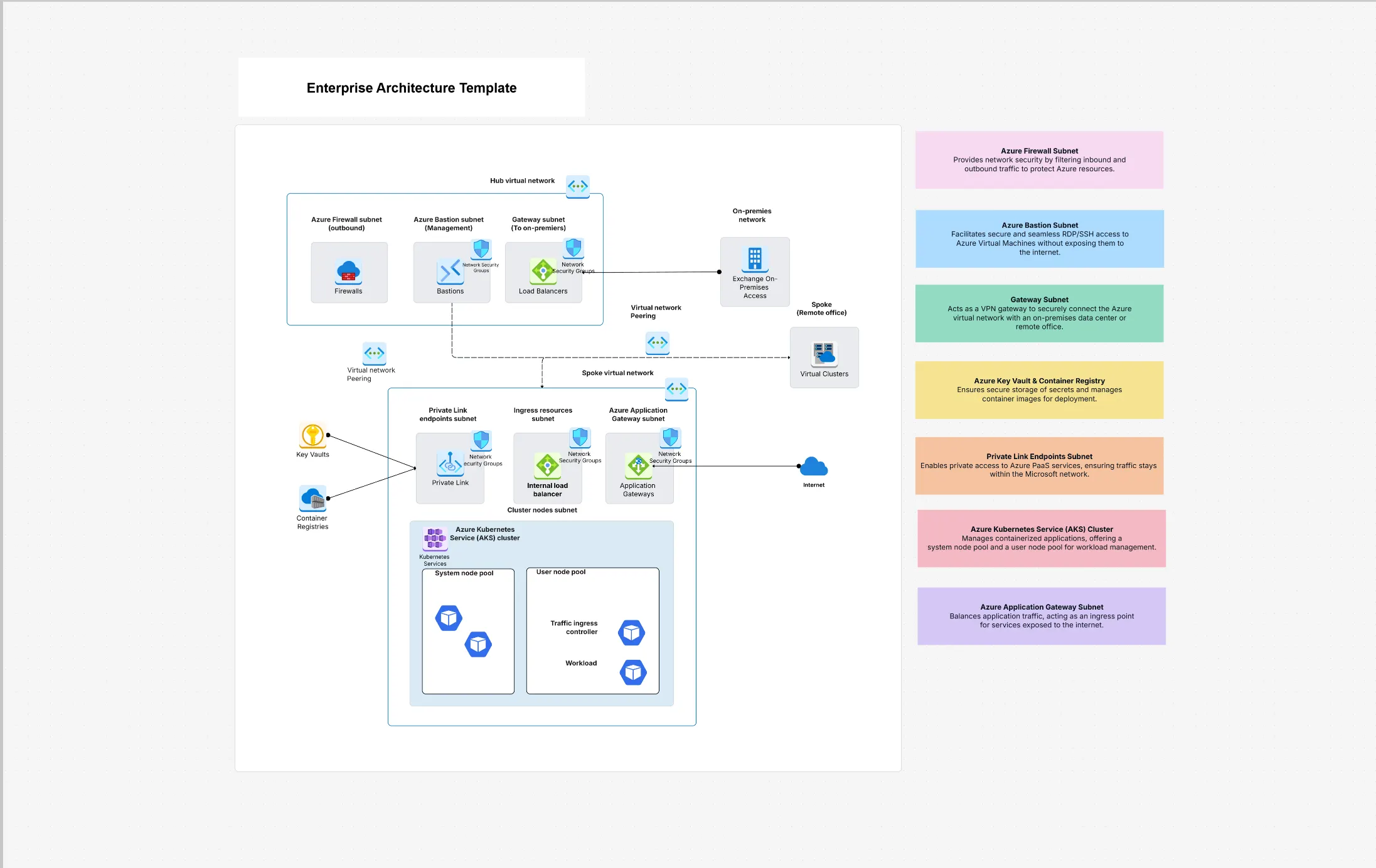
Enterprise architecture diagram template

Cloudairy
 Copy link

Get your team started in minutes
Sign up with your work email for seamless collaboration.
Whiteboard
Copy link

Use this editable enterprise architecture diagram template to strategically align your IT systems with business goals. Visualize applications, data, and infrastructure layers to ensure technology supports organizational objectives, improves efficiency, and drives informed decision-making.
Use this editable enterprise architecture diagram template to strategically align your IT systems with business goals. Visualize applications, data, and infrastructure layers to ensure technology supports organizational objectives, improves efficiency, and drives informed decision-making.
The enterprise architecture diagram template maps strategy to execution across business, application, data, and technology layers. Unlike project-level software architecture diagrams, an enterprise view spans portfolios, standards, and capability models. With this enterprise system architecture diagram, leaders see duplication, gaps, and risks while governance gains a common language to prioritize investments, rationalize platforms, and track modernization across regions and business units.
This section structures your enterprise architecture diagram so capabilities, applications, and platforms are consistently represented. By using layered viewpoints, the enterprise system architecture diagram clarifies ownership and cost centers, enabling portfolio-level decisions. The four H3s below (business, application, data, technology) ensure your diagrams stay consistent with TOGAF-style practices while remaining readable for executives.
The business layer links enterprise capabilities and processes to measurable value. In an enterprise architecture diagram, this layer clarifies why systems exist and which outcomes they enable. By modeling capabilities rather than org charts, the enterprise system architecture diagram remains stable through reorganizations, helping prioritize initiatives and de-duplicate effort across functions.
Applications realize capabilities. This H3 explains how to represent platforms and services in the enterprise architecture diagram so impacts of change are visible. Show lifecycle states and dependencies so the enterprise system architecture diagram supports road-mapping and consolidation.
Data underpins decisions and compliance. This H3 positions stewardship and lineage in the enterprise architecture diagram so audits and analytics succeed. By separating domains, the enterprise system architecture diagram keeps semantics consistent across regions.
Infrastructure enables scale and security. This H3 frames platforms in the enterprise architecture diagram so constraints are explicit. By standardizing stacks, the enterprise system architecture diagram lowers cost and incident rates.
Adopt this enterprise architecture diagram template when coordinating modernization, M&A rationalization, or compliance across portfolios. Because the enterprise system architecture diagram reveals duplication and risk, it supports budgeting, vendor strategy, and sequencing of programs without guesswork.
Tune the enterprise architecture diagram template by importing capability maps, CMDB data, and cost tags. Keep views small and purposeful. With consistent icons and legends, the enterprise system architecture diagram remains readable as your estate evolves.
Use this enterprise architecture diagram to coordinate strategy and operations at scale. The enterprise system architecture diagram becomes the anchor for steering committees and architecture review boards.
An enterprise architecture diagram connects capabilities to platforms and policies so leaders can modernize with confidence. With layered views, the enterprise system architecture diagram turns complexity into decisions.
Loading subcategories...
 Manage all your work in one place
Collaborate with your team
Use Cloudairy for FREE—forever
Explore More