Open the template free, tell the AI who your customer is and what they're trying to do, and walk into the workshop with stages, touchpoints, and emotion rows already on the board.
Free plan - 3 editable items, 30 AI credits/month, unlimited members
No credit card required
SOC 2 Type II, ISO 27001, GDPR
1,000,000+ Trusted Users with
Trusted by Professionals at Leading Companies
What Is a Customer Journey Map Template?
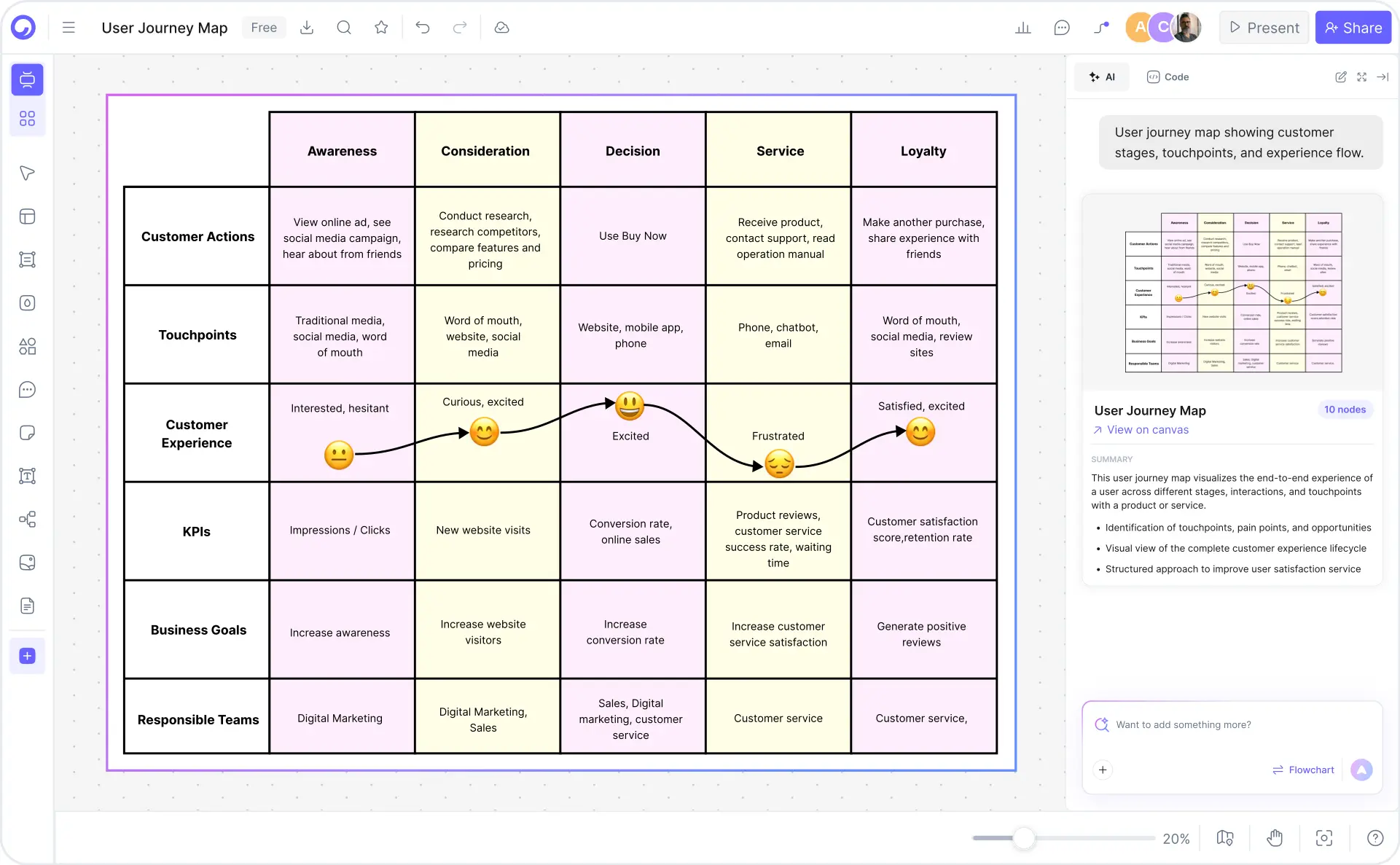
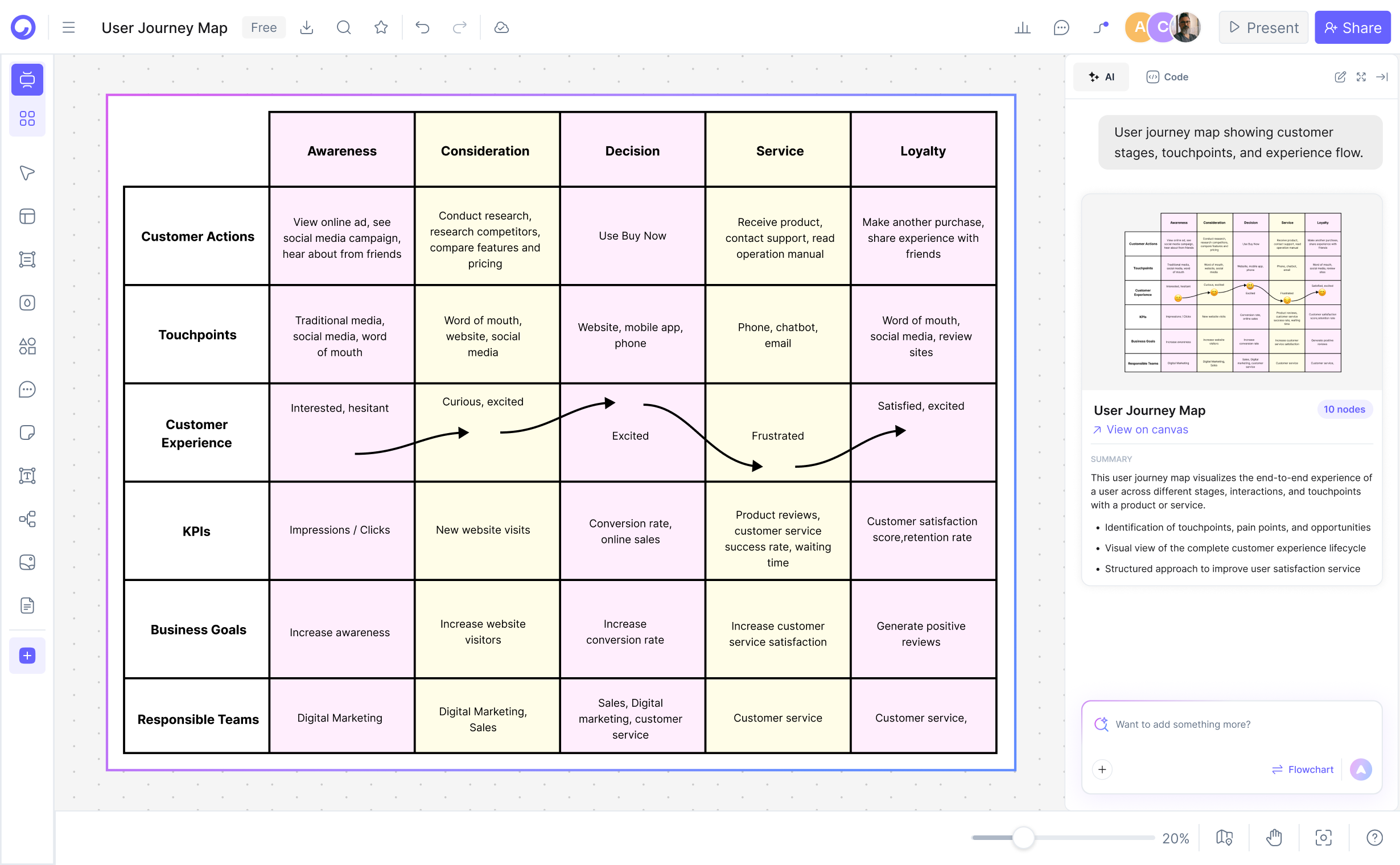
A customer journey map template is a pre-built grid for mapping how a customer experiences your product, stage by stage. This one ships with five stages, a persona slot, and rows for touchpoints, actions, emotions, pain points, and opportunities - so your team fills in insight instead of drawing boxes.
Starting from a journey map template beats a blank whiteboard for one reason: structure. The rows force the questions that matter - what is the customer doing, where does it happen, how do they feel - and the stages keep a room full of opinions moving left to right instead of in circles.
It's free in the real sense: open it on Cloudairy's free plan, no credit card. And if you're further along - evaluating dedicated journey tools rather than grabbing a template - the customer journey mapping software comparison covers pricing and trade-offs honestly.
What's Inside the Template
Six rows, five stages. Every row answers one question about the journey - together they turn scattered anecdotes into a map the whole team reads the same way.
Row
What it captures
Persona
Who this journey is about - one named persona per map. Mapping two personas? Duplicate the board rather than blending them into an average nobody recognizes.
Stages
Five columns from Awareness to Advocacy, running left to right. Rename or delete them to match your funnel - B2B teams often add a Procurement stage.
Touchpoints
Where each interaction actually happens: an ad, the pricing page, a sales call, the onboarding email, a support chat.
Customer actions
What the customer is doing at each stage, in their words - "comparing three vendors in a spreadsheet", not your feature names.
Emotions
A curve from frustrated to delighted across the stages. The dips are where churn starts - plot them honestly or the map flatters you into inaction.
Opportunities
What you'll fix or test at each dip. The rule that makes the map useful: every opportunity gets an owner before the session ends.
How to Use the Customer Journey Map Template in 3 Steps
From an empty persona slot to a workshop-ready map in about ten minutes.
Step 1 - Open it free: Sign up and open the template - the grid arrives with the stages and rows already laid out. The free plan covers 3 editable items, 30 AI credits a month, and unlimited members, so the whole workshop group can join without a license discussion.
Step 2 - Let AI pre-fill the stages: Give the AI journey map maker one plain-English line - persona plus scenario, like "first-time buyer choosing project software for a 10-person team" - and it drafts the stages, touchpoints, and an emotion curve. You edit a draft instead of inventing from zero.
Step 3 - Run the session live: Invite the team and walk the map stage by stage - drag sticky notes, mark the emotional dips, and give every opportunity an owner before the call ends. Share the board link afterwards; it stays current as the map evolves.
The template runs on Cloudairy's online whiteboard, so the workshop tools - sticky notes, voting, comments, live cursors - are already on the canvas.
One Customer Journey Template, Four Common Variants
Rename the stages and the same grid maps almost any journey. These are the four variants teams build most often - and what changes in each.
B2B Customer Journey
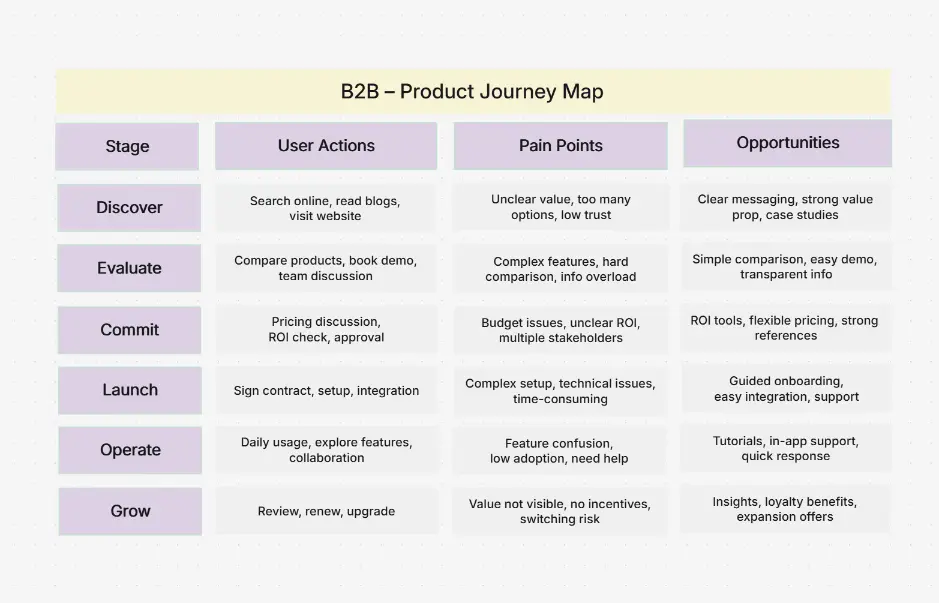
A b2b customer journey map has more people in it than customers. Add a row for the champion, the economic buyer, and procurement, and stretch the timeline - a nine-month cycle with a security review in the middle is normal. Map where deals stall, not just where users click.
SaaS Onboarding Journey
Zoom into a single stage: the first 14 days after signup. Touchpoints are welcome emails, empty states, and the first aha moment. Map the gap between "created an account" and "did the thing your product is for" - that gap is where most trials quietly die.
Retail Purchase Journey
Runs from discovery to unboxing across web, app, and store. The interesting entries are the channel switches - browsed on mobile, bought on desktop, returned in store. Mark every point where the cart, stock information, or loyalty points fail to follow the customer across channels.
Support Experience Journey
Starts at "something broke" and ends at "would they recommend you anyway". Map ticket, chat, and help-doc touchpoints against the emotion row. A fast, human resolution is one of the few dips you can turn into a peak - which is why this variant pays for itself first.
Related Templates & Tools
Journey mapping rarely travels alone. These are the boards teams open next - and the comparison to read if you're weighing dedicated tools.
The same six rows, four very different meetings. Here's what each role actually does with the map:
CX leads defending a fix list
You own NPS and the quarterly "why is churn up" question. Map the current journey with real ticket and survey data, mark the three worst dips, and walk into the exec review with fixes attached to stages instead of anecdotes.
Product managers before the roadmap fight
Map the journey first, argue priorities second. When "improve onboarding" becomes "the day-3 empty state is where trials stall", the roadmap conversation gets shorter - and the map is the artifact you paste straight into the PRD.
UX researchers making findings stick
You have interview notes nobody reads. Synthesize them onto the map live in the debrief - quotes as sticky notes under each stage - and the research lands as a picture the team remembers instead of a report they skim.
Agency strategists running discovery
Every discovery phase needs a journey workshop. Keep one board per client, pre-fill it with AI from the brief before kickoff, and leave the client with a map that makes the rest of the engagement - and the invoice - make sense.
Customer Journey Map Template FAQs
Yes. Open it on Cloudairy's free plan - 3 editable items, 30 AI credits per month, unlimited members, no credit card. That's enough to map a full journey and run the workshop with your whole team editing. Paid plans start at $8 per member per month when you need unlimited boards.
Yes. Describe the persona and scenario in one line - 'small-business owner switching payroll providers' - and Cloudairy's AI drafts the stages, touchpoints, actions, and an emotion curve. You get a first draft to argue with instead of a blank grid, which is exactly what a workshop needs. The free plan includes 30 AI credits a month.
Pre-fill the map with AI before the session so nobody stares at an empty grid. In the workshop, walk left to right one stage at a time: touchpoints first, then what the customer does, then how they feel. Timebox it to 90 minutes, capture disagreements as sticky notes, and end by assigning an owner to every opportunity row.
A b2b customer journey map tracks a buying committee, not a person - champion, economic buyer, IT, procurement - across a cycle that can run months and stall at legal or security review. B2C journeys usually follow one person over days, with emotion driving the purchase. Same grid either way: rename the stages and add a row per stakeholder.
Less than you think. Support tickets, funnel analytics, sales-call notes, and a handful of customer interviews cover most maps. Don't wait for perfect research - map the journey as the team believes it works, mark each guess with a question mark, and let the gaps set your research agenda. The map improves as evidence replaces assumptions.
Yes. Share a live board link so stakeholders always open the current version, or export to PNG, SVG, or PDF for decks and reports. Real-time collaboration works on every Cloudairy plan, including Free - reviewers can comment without touching the map.
Five to seven for most teams. The template ships with five - Awareness, Consideration, Decision, Onboarding, Advocacy - and every stage is renameable. Under five and the story loses its turning points; past seven the workshop drags. If one stage sparks a long argument, that's usually a sign it should be split - or mapped on its own board.
The template is the artifact; the software question is about where it lives. If you map journeys a few times a year, this free template inside Cloudairy's workspace is plenty. Dedicated journey platforms earn their price when journey analytics is someone's full-time job. Our customer journey mapping software comparison walks through the tools, pricing, and when upgrading is worth it.
Yes. Cloudairy is certified for SOC 2 Type II, ISO 27001 and GDPR. Enterprise features include SAML SSO (via Okta, OneLogin, Auth0), SCIM provisioning, audit logs, custom data residency (US or EU), and a 99.9% uptime SLA.
Trust is the foundation
Secure, compliant, and enterprise-ready.
Cloudairy safeguards your work with enterprise-grade security, compliance, and access controls — so your teams can create, collaborate, and scale with confidence.